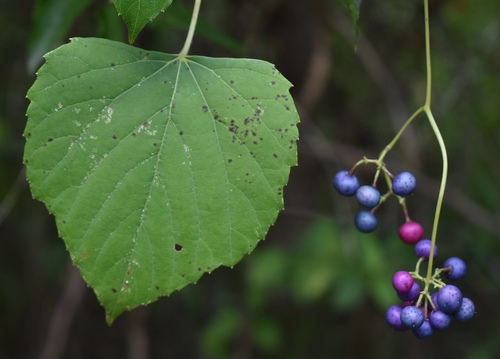


Heart Leaf Peppervine
ampelopsis cordata
The Heart Leaf Peppervine (Ampelopsis cordata) is a vigorous, native woody vine found predominantly in the southeastern and central United States. Renowned for its rapid growth and ornamental appeal, this species adds significant ecological value to its habitats. It's particularly notable for its distinctive foliage and the striking clusters of berries it produces, which undergo a vibrant color transformation throughout the growing season. Beyond its aesthetic qualities, the peppervine plays a crucial role in local ecosystems by providing food and shelter for various wildlife species, making it an interesting subject for nature enthusiasts and a vital component of riparian and woodland edge communities.
Lebensraum: Found in moist, open woodlands, forest edges, stream banks, floodplains, and disturbed areas, often climbing on fences, shrubs, and trees.
Heart Leaf Peppervine is characterized by its alternate, simple, heart-shaped (cordate) leaves, which can be shallowly lobed or unlobed, displaying a bright green hue throughout summer and often turning reddish in the fall. The vine climbs using slender, branched tendrils. Its inconspicuous, small greenish-white flowers develop into pea-sized berries clustered along the stems. These berries are a key identifying feature, evolving from green to a range of vivid pink, blue, and eventually dark purple or black when mature, often displaying multiple colors simultaneously within a single cluster.
Kategorie
PflanzenSeltenheit
Common
Gefahr
1/5 · Sehr gering
Snaps
Mach den ersten Snap!
As a member of the Vitaceae family, it is a relative of cultivated grapevines and shares the characteristic of climbing with specialized tendrils.
Despite their vibrant appearance, the berries of Heart Leaf Peppervine are generally considered unpalatable to humans and can cause mild digestive upset if consumed in large quantities.
Its abundant and colorful berries are a crucial food source for numerous bird species, particularly in late summer and fall, facilitating the vine's broad seed dispersal.
The name 'peppervine' is thought to derive from the slightly acrid taste of its leaves or fruits, although it is not related to true pepper plants.
The vine possesses specialized tendrils that coil and grip onto surrounding vegetation or structures, allowing it to rapidly ascend and reach optimal light conditions within its environment.
It produces striking clusters of berries that transition through an array of colors from green to pink, blue, and purple, attracting a diverse range of birds for effective seed dispersal.
Heart Leaf Peppervine exhibits remarkable tolerance to varying light conditions and soil types, enabling it to thrive in both pristine natural areas and more disturbed, successional landscapes.
As an autotrophic plant, Heart Leaf Peppervine synthesizes its own food through photosynthesis. It converts sunlight, carbon dioxide from the atmosphere, and water absorbed from the soil into sugars for energy and growth.
Apiformes (various species)
Provides nectar for pollination.
Turdus migratorius
Consumes berries, aiding in seed dispersal.
Odocoileus virginianus
Browses on foliage.
Various genera
Utilizes as a climbing support structure.
Für dieses Objekt sind noch keine Merkmal-Badges vergeben.
Noch keine Alternativnamen vorhanden.
Sammlungen für dieses Objekt erscheinen hier, wenn weitere Themen hinzugefügt werden.
Gefahr
1/5 · Sehr gering
Noch keine besonderen Sicherheitshinweise.
Der einfachste Weg, Heart Leaf Peppervine zu bestimmen, ist die Verwendung der Naturführer-App Snappit.
300-1000 cm
1-10 kg
10-50 Jahre
As an autotrophic plant, Heart Leaf Peppervine synthesizes its own food through photosynthesis. It converts sunlight, carbon dioxide from the atmosphere, and water absorbed from the soil into sugars for energy and growth.
Found in moist, open woodlands, forest edges, stream banks, floodplains, and disturbed areas, often climbing on fences, shrubs, and trees.
Light Absorption
Zoome hinein, um Cluster aufzulösen und zu sehen, wo dieses Objekt fotografiert wurde.
Neueste Snaps erscheinen hier, wenn neue Beobachtungen hinzukommen.













