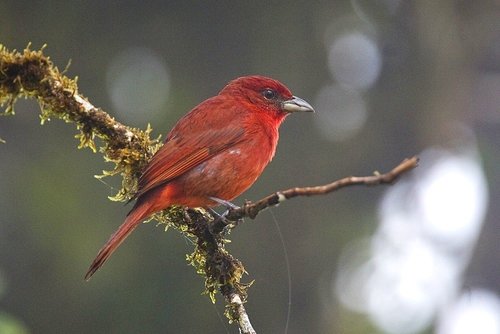


Hepatic Tanager
piranga flava
The Hepatic Tanager (Piranga flava) is a striking, medium-sized songbird that graces the pine-oak woodlands of the Americas. Its common name, 'hepatic', originates from the Greek word for liver, a direct reference to the adult male’s muted, grayish brick-red plumage. While they share the vibrant hues typical of tanagers, recent genetic studies have revealed that they actually belong to the cardinal family (Cardinalidae). Unlike the hyperactive warblers that often share their habitat, Hepatic Tanagers are known for their sluggish, deliberate foraging style as they carefully glean insects from the high forest canopy. They occupy an incredibly vast geographic range, stretching from the southwestern United States all the way down to Argentina. Across this massive expanse, they exhibit remarkable adaptability to various mountainous and highland forest environments. For birdwatchers, spotting one is a delightful reward, often requiring patience and a keen ear for their distinctive, harsh 'chuck' call echoing through the pines. Their presence is a wonderful indicator of healthy, mature pine-oak woodland ecosystems.
Lebensraum: Found primarily in open montane pine, pine-oak, and oak woodlands, often foraging deliberately high in the forest canopy.
Males are distinctively liver-red (a brick-red with grayish tinges), displaying a darker back and brighter underparts, offset by a prominent dark grayish patch on the cheeks (auriculars). Females, by contrast, are a dusky mustard yellow or olive-yellow, also bearing the characteristic dark cheek patch and a grayish back. Both sexes feature a rather stout, dark, slightly hooked beak, which is noticeably heavier than that of other North American tanagers. They measure roughly 17 to 20 centimeters in length with a wingspan of about 30 to 33 centimeters, presenting a somewhat chunky, large-headed silhouette when perched high in the canopy.
Kategorie
VögelSeltenheit
Common
Gefahr
1/5 · Sehr gering
Snaps
Mach den ersten Snap!
Despite their common name, genetic testing has proven that Hepatic Tanagers—along with all North American Piranga tanagers—are actually members of the cardinal family.
The word 'hepatic' means 'relating to the liver', perfectly describing the adult male's unique, muted brick-red coloration.
They have one of the largest continuous ranges of any songbird in the Americas, spanning from Arizona and New Mexico all the way down to Argentina.
Unlike many brightly colored birds that dart quickly through the trees, the Hepatic Tanager is famously sluggish, moving deliberately like a parrot when hunting for insects.
Their unusually thick, slightly hooked bill is perfectly adapted for crushing the hard exoskeletons of beetles and plucking wild fruits.
They utilize a methodical, slow-moving foraging technique to carefully inspect leaves and bark, allowing them to spot exceptionally camouflaged insects.
They use a sharp, low 'chuck' call that cuts through dense foliage, allowing mates and family members to stay in contact across wide forest territories.
They consume a balanced diet of forest insects, spiders, and seasonal wild berries.
Altersunterschiede: Nestlings are fed an almost exclusively insectivorous diet, especially soft-bodied caterpillars, before incorporating fruit as adults.
Pinus ponderosa
Provides crucial nesting habitat, cover, and foraging grounds for the tanager.
Accipiter cooperii
Avian predators that actively hunt tanagers and other songbirds in wooded environments.
Dendroctonus ponderosae
Hepatic Tanagers help control populations of these potentially destructive forest insects.
Für dieses Objekt sind noch keine Merkmal-Badges vergeben.
Noch keine Alternativnamen vorhanden.
Sammlungen für dieses Objekt erscheinen hier, wenn weitere Themen hinzugefügt werden.
Gefahr
1/5 · Sehr gering
Noch keine besonderen Sicherheitshinweise.
Der einfachste Weg, Hepatic Tanager zu bestimmen, ist die Verwendung der Naturführer-App Snappit.
17-20 cm
30-33 cm
0.028-0.045 kg
5-8 Jahre
40 km/h
They consume a balanced diet of forest insects, spiders, and seasonal wild berries.
Found primarily in open montane pine, pine-oak, and oak woodlands, often foraging deliberately high in the forest canopy.
Zoome hinein, um Cluster aufzulösen und zu sehen, wo dieses Objekt fotografiert wurde.
Neueste Snaps erscheinen hier, wenn neue Beobachtungen hinzukommen.




.jpg&width=800)







