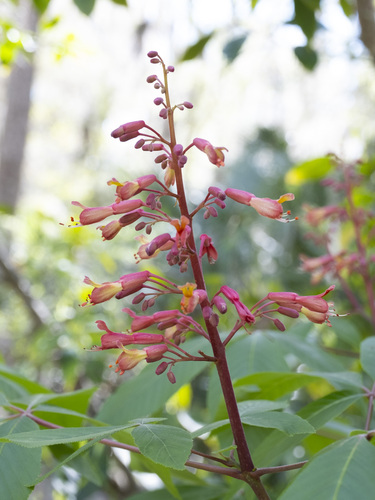
Hercules' club
Zanthoxylum clava-herculis
Hercules' club is a unique plant with thick, spiky branches. It grows in warm areas and has bright green leaves that can be very pretty. This plant is named after the strong hero Hercules!
Lebensraum: Coastal areas
The Hercules' club is a striking tree with a distinctive trunk covered in corky, cone-shaped thorns. Its compound leaves are shiny green, turning yellowish in fall. Small, clustered yellowish-green flowers lead to tiny, dark, capsule-like fruits.
Kategorie
PflanzenSeltenheit
Common
Gefahr
2/5 · Gering
Snaps
Mach den ersten Snap!
It's called "Hercules' club" because its thorny trunk looks like the legendary hero's weapon!
Its bark contains chemicals that create a buzzing, tingling feeling on your tongue!
Many butterflies, like the Giant Swallowtail, lay their eggs only on this special tree!
Some birds love to eat its tiny, black berries, helping to spread its seeds far and wide!
Hercules' club has formidable, cone-shaped thorns on its trunk that protect it from hungry herbivores.
The bark of Hercules' club contains compounds that can cause a tingling, numbing sensation, deterring pests.
Hercules' club can thrive in dry, sandy soils thanks to its deep root system, helping it survive droughts.
Papilio cresphontes
Its leaves are food for the butterfly's larvae.
Apis mellifera
Bees visit its small flowers for nectar and pollen.
Turdus migratorius
Robins consume its small, dark berries, spreading seeds.
Aromatische Pflanzen produzieren und verströmen duftende flüchtige organische Verbindungen, oft zur Abwehr oder um Bestäuber anzulocken.
Blütenpflanzen sind alle Pflanzen, die als Teil ihres Fortpflanzungszyklus Blüten bilden.
Duftende Blüten verströmen ein angenehmes Aroma, oft um Bestäuber anzulocken oder zur Abwehr.
Immergrüne Pflanzen behalten ihr Laub das ganze Jahr über und werfen nie alle Blätter auf einmal ab.

Laubbäume sind Bedecktsamer, die sich durch flache, breite Blätter auszeichnen, welche in gemäßigten Klimazonen typischerweise jährlich abgeworfen werden.

Heilpflanzen besitzen chemische Verbindungen, die für therapeutische Zwecke zur Behandlung von Krankheiten oder zur Erhaltung der Gesundheit eingesetzt werden können.

Besitzt scharfe, spitze Vorsprünge oder Stacheln auf dem Körper oder der Oberfläche.

Küstenlebensräume sind dynamische Umgebungen an der Schnittstelle zwischen Land und Meer, die von Gezeiten, Wellen und Salzwasser geprägt sind.

Der Status 'Stark gefährdet' bedeutet, dass eine Art in naher Zukunft einem sehr hohen Risiko ausgesetzt ist, in freier Wildbahn auszusterben.
Gefahr
2/5 · Gering
Be careful around the spiky branches; they can be sharp!
1000-1800 cm
400-800 cm
0.2-0.5 cm
Late spring to early summer
Nein
Leicht
Mehrjährig
Insekten
Zoome hinein, um Cluster aufzulösen und zu sehen, wo dieses Objekt fotografiert wurde.
Neueste Snaps erscheinen hier, wenn neue Beobachtungen hinzukommen.