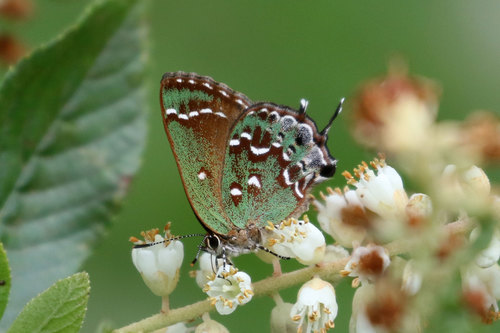


Hessel'S Hairstreak
callophrys hesseli
Hessel's Hairstreak (Callophrys hesseli) is a rare, delicate butterfly renowned for its striking emerald-green underwings and its strict ecological dependence on Atlantic white cedar swamps. First discovered in the mid-20th century, this small lepidopteran spends most of its life high in the forest canopy, making it a highly prized sighting for butterfly enthusiasts. Its life cycle is intimately synchronized with its host plant, where it lays its eggs and where the cryptically colored caterpillars feed on cedar needles. As wetlands and cedar forests face ongoing threats from development and climate change, Hessel's Hairstreak serves as a vital bioindicator of swamp ecosystem health. Observing these butterflies requires patience, as they rarely descend to the ground except to nectar on nearby flowering shrubs, offering a fleeting glimpse of their brilliant, jewel-like coloration.
Lebensraum: Strictly restricted to Atlantic white cedar swamps and adjacent wet bogs along the eastern coast of the United States.
This small butterfly is easily identified by the vibrant, moss-green coloration of its underwings, which is accented by a series of postmedian lines consisting of white dashes bordered by reddish-brown. Unlike the similar Juniper Hairstreak, Hessel's Hairstreak has a distinct offset white spot near the forewing margin and a warmer brown tone on its upperwing surfaces. Its wingspan ranges from 2 to 3 centimeters, and when perched with closed wings, it perfectly mimics a fresh cedar scale.
Kategorie
InsektenSeltenheit
Common
Gefahr
1/5 · Sehr gering
Snaps
Mach den ersten Snap!
Because they spend almost their entire lives high in the cedar canopy, they are rarely seen unless drawn down by blooming nectar plants nearby.
Hessel's Hairstreak was not recognized as a distinct species until 1950, despite inhabiting regions near major East Coast cities.
The bright green color on their wings is not caused by green pigment, but by microscopic structures that refract light.
The vivid green and brown patterns on the underside of its wings allow the butterfly to perfectly mimic Atlantic white cedar scales, blending seamlessly with the canopy to evade avian predators.
The larvae possess specialized digestive enzymes that enable them to feed exclusively on the scale-like leaves of Atlantic white cedar, ignoring other conifers.
Adults are highly adapted to life in the forest canopy, utilizing rapid, erratic flight patterns to navigate dense branches and wind currents high above the swamp floor.
Larvae feed exclusively on the foliage of Atlantic white cedar, while adults drink nectar from a variety of nearby flowering shrubs.
Chamaecyparis thyoides
Lays eggs on this tree, which serves as the sole food source for its larvae.
Vaccinium corymbosum
Adult butterflies feed on the nectar of these flowers during the spring.
Peucetia viridans
Preys upon adult butterflies resting on low-lying vegetation.
Für dieses Objekt sind noch keine Merkmal-Badges vergeben.
Noch keine Alternativnamen vorhanden.
Sammlungen für dieses Objekt erscheinen hier, wenn weitere Themen hinzugefügt werden.
Gefahr
1/5 · Sehr gering
Noch keine besonderen Sicherheitshinweise.
Der einfachste Weg, Hessel'S Hairstreak zu bestimmen, ist die Verwendung der Naturführer-App Snappit.
1+ cm
2+ cm
0.0001+ kg
1+ Jahre
12 km/h
Larvae feed exclusively on the foliage of Atlantic white cedar, while adults drink nectar from a variety of nearby flowering shrubs.
Strictly restricted to Atlantic white cedar swamps and adjacent wet bogs along the eastern coast of the United States.
Zoome hinein, um Cluster aufzulösen und zu sehen, wo dieses Objekt fotografiert wurde.
Neueste Snaps erscheinen hier, wenn neue Beobachtungen hinzukommen.












_Chrysoperla_carnea_-_dorsal_view.jpg&width=800)