

High Noon Ant
forelius pruinosus
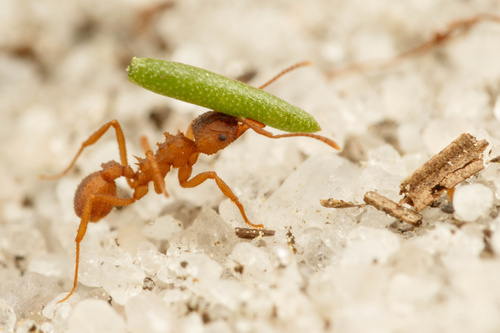
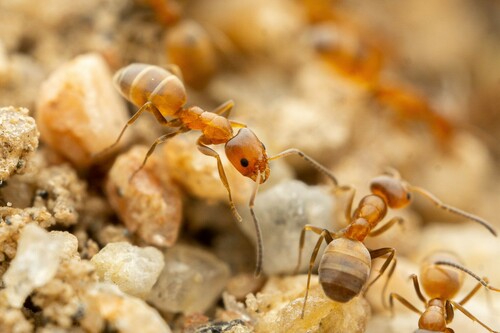
The High Noon Ant (Forelius pruinosus) is a remarkable and resilient little insect celebrated for its extraordinary heat tolerance. While most other creatures retreat to the shade during the scorching heat of the midday sun, these tiny ants thrive, actively foraging across hot pavements and sandy soils. This unique timing allows them to exploit food sources without competition from more dominant, heat-sensitive ant species. They form large, multi-queen colonies and are highly efficient foragers, communicating rapidly through chemical trails. Their presence in open, sunny environments makes them a common yet fascinating sight for urban and rural nature spotters alike.
Lebensraum: Typically found in dry, open habitats with sparse vegetation, such as sandy fields, prairies, dunes, and urban sidewalks.
These tiny ants typically measure between 1.8 to 2.5 millimeters in length. They range in color from a dark brown to nearly black, but what truly distinguishes them is a fine, silvery-gray pubescence covering their bodies. This microscopic coating gives them a frosted or 'pruinose' appearance under bright light. They have a relatively smooth, single-segmented petiole that is flattened and hidden beneath the front of their abdomen, and they lack a functional stinger, relying instead on chemical defenses.
Kategorie
InsektenSeltenheit
Common
Gefahr
1/5 · Sehr gering
Snaps
Mach den ersten Snap!
They are nicknamed 'high noon ants' because their peak activity occurs during the hottest hours of the day when most other insects seek shelter.
Unlike many ant species with a single queen, High Noon Ant colonies are polygynous, meaning they can contain multiple functional queens.
When crushed, these ants release a distinct, pungent odor that is often compared to the smell of rotten coconuts or blue cheese.
They can forage at surface temperatures exceeding 50 degrees Celsius, allowing them to utilize resources when competitors are inactive.
They lay down highly volatile chemical trails from their hindguts, allowing rapid, coordinated mass recruitment to newly discovered food sources.
The fine silvery hair on their bodies reflects solar radiation, helping to prevent overheating while foraging in direct sunlight.
They primarily feed on honeydew secreted by aphids and scale insects, supplemented by scavenging on dead insects and floral nectar.
Aphis nerii
Tends these aphids to harvest their sugary honeydew secretions, protecting them from ladybugs and other predators.
Solenopsis invicta
Competes for foraging space, using its high heat tolerance to forage when the aggressive fire ants are inactive.
Für dieses Objekt sind noch keine Merkmal-Badges vergeben.
Noch keine Alternativnamen vorhanden.
Sammlungen für dieses Objekt erscheinen hier, wenn weitere Themen hinzugefügt werden.
Gefahr
1/5 · Sehr gering
Noch keine besonderen Sicherheitshinweise.
Der einfachste Weg, High Noon Ant zu bestimmen, ist die Verwendung der Naturführer-App Snappit.
They primarily feed on honeydew secreted by aphids and scale insects, supplemented by scavenging on dead insects and floral nectar.
Typically found in dry, open habitats with sparse vegetation, such as sandy fields, prairies, dunes, and urban sidewalks.
Foraging
Zoome hinein, um Cluster aufzulösen und zu sehen, wo dieses Objekt fotografiert wurde.
Neueste Snaps erscheinen hier, wenn neue Beobachtungen hinzukommen.