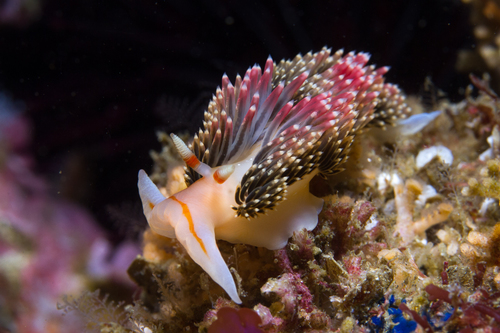


Hilton'S Aeolid
phidiana hiltoni
Hilton's Aeolid (Phidiana hiltoni) is a remarkably striking and unusually pugnacious sea slug found along the rocky Pacific coast of North America. Unlike many docile marine invertebrates, this aeolid nudibranch is known for its aggressive nature, frequently attacking other nudibranchs and even members of its own species. It possesses a fascinating defense mechanism: it feeds on stinging hydroids and sequesters their functional stinging cells (nematocysts) in the tips of its colorful, finger-like projections (cerata), using them to ward off predators.
Lebensraum: Typically found in low-intertidal rocky reefs, tide pools, and shallow subtidal zones along wave-swept shores.
This medium-sized nudibranch reaches lengths of up to 5 cm, featuring an elongated translucent white to pale pink body. It is distinguished by numerous densely packed, pointed cerata on its back, which are colored bright orange, reddish-brown, or brown, and tipped with a brilliant white band. Its head is equipped with long, elegant oral tentacles and a pair of rhinophores that are pale yellow or orange at their bases, making it highly visible in tide pools.
Kategorie
InvertebrateSeltenheit
Common
Gefahr
1/5 · Sehr gering
Snaps
Mach den ersten Snap!
Hilton's Aeolid is nicknamed the 'pugnacious nudibranch' because of its readiness to physically fight and bite other sea slugs.
If it loses its cerata during a fight or predator attack, it can regenerate them completely within a few weeks.
The white tips on its cerata act like warning beacons to visual predators, advertising the stolen stinging cells packed inside.
Sequesters functional stinging cells from its hydroid prey and moves them to the tips of its cerata for defense.
Displays highly aggressive behavior, actively biting and attacking other nudibranchs that enter its territory.
Can readily cast off its cerata when physically harassed by a predator, distracting the attacker while escaping.
An aggressive carnivore that primarily feeds on hydroids, but routinely attacks and consumes bryozoans and other species of nudibranchs.
Abietinaria amphora
Phidiana hiltoni feeds extensively on this hydroid species, acquiring its stinging cells.
Hermissenda crassicornis
Phidiana hiltoni actively attacks and preys upon this competing nudibranch species.
Navanax inermis
This large predatory sea slug is known to hunt and eat Hilton's Aeolid.
Für dieses Objekt sind noch keine Merkmal-Badges vergeben.
Noch keine Alternativnamen vorhanden.
Sammlungen für dieses Objekt erscheinen hier, wenn weitere Themen hinzugefügt werden.
Gefahr
1/5 · Sehr gering
Noch keine besonderen Sicherheitshinweise.
Der einfachste Weg, Hilton'S Aeolid zu bestimmen, ist die Verwendung der Naturführer-App Snappit.
2+ cm
0.001+ kg
1+ Jahre
An aggressive carnivore that primarily feeds on hydroids, but routinely attacks and consumes bryozoans and other species of nudibranchs.
Typically found in low-intertidal rocky reefs, tide pools, and shallow subtidal zones along wave-swept shores.
Pursuit
10005000+
Zoome hinein, um Cluster aufzulösen und zu sehen, wo dieses Objekt fotografiert wurde.
Neueste Snaps erscheinen hier, wenn neue Beobachtungen hinzukommen.











