

Himantoglossum Metlesicsianum
himantoglossum metlesicsianum
Himantoglossum metlesicsianum, commonly known as Metlesics's Giant Orchid, is a rare and striking orchid species endemic to the island of Tenerife in the Canary Islands. It is a robust geophyte characterized by its thick, fleshy stems and dense, imposing spikes of colorful flowers. Adapted to the challenging volcanic terrains, this plant spends the dry summer dormant underground as a tuber, only emerging during the cooler winter months when moisture levels rise. It represents a vital and unique evolutionary branch of orchid flora in Macaronesia.
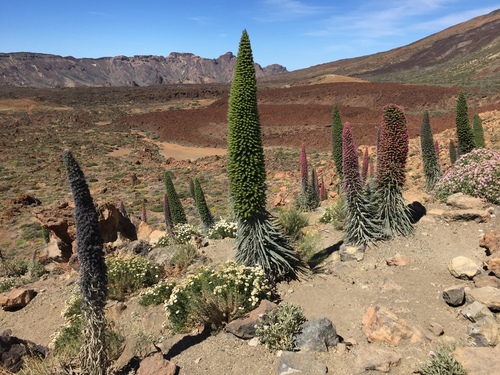
Lebensraum: Found in open Canary Island pine forests, volcanic scrublands, and rocky slopes with porous ash soils, usually at altitudes between 500 and 1,200 meters.
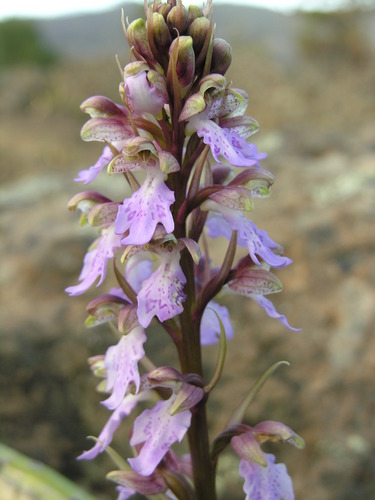
This robust orchid typically stands between 15 and 60 centimeters tall, featuring a thick green stem often flushed with purple. The leaves are large, shiny, and broadly oval, forming a basal rosette that emerges before the flower spike. The inflorescence is a dense, cylindrical cluster of 20 to 40 flowers, each adorned with a prominent, deeply three-lobed pinkish-purple to brownish lip covered in darker violet spots. A short, downward-pointing spur is visible behind each flower.
Kategorie
PflanzenSeltenheit
Common
Gefahr
1/5 · Sehr gering
Snaps
Mach den ersten Snap!
Like most orchids, its seeds are as fine as dust and possess no food reserves, depending entirely on a fungal partner for the energy to grow.
The species name 'metlesicsianum' was chosen to honor Hans Metlesics, an Austrian botanist who dedicated much of his life to cataloging Canarian flora.
This orchid is one of the earliest blooming flowers in the Canary Islands, with blossoms opening as early as December.
It relies on symbiotic mycorrhizal fungi in the soil to provide essential carbon and nutrients, particularly during seed germination.
Exhibits exceptional tolerance to porous, nutrient-poor volcanic soils, utilizing underground tubers to store energy and survive summer droughts.
Employs food-deceptive mimicry, attracting local insect pollinators with bright colors and floral scent without producing actual nectar.
As a photosynthetic plant, it produces its own sugars using sunlight, water, and carbon dioxide, while relying on mycorrhizal fungi for mineral uptake.
Altersunterschiede: As microscopic seeds and young protocorms, they are entirely mycoheterotrophic, depending 100% on host fungi before developing green leaves to photosynthesize.
Pinus canariensis
Grows in the shelter of this endemic pine forest, benefiting from the shaded microclimate and acidic leaf litter.
Bombus canariensis
Attracted to the showy, deceptive flowers, this endemic bee acts as a primary pollinator.
Tulasnella calospora
Provides essential nutrients to the germinating seeds of the orchid in the volcanic soil.
Für dieses Objekt sind noch keine Merkmal-Badges vergeben.
Noch keine Alternativnamen vorhanden.
Sammlungen für dieses Objekt erscheinen hier, wenn weitere Themen hinzugefügt werden.
Gefahr
1/5 · Sehr gering
Noch keine besonderen Sicherheitshinweise.
Der einfachste Weg, Himantoglossum Metlesicsianum zu bestimmen, ist die Verwendung der Naturführer-App Snappit.
15-60 cm
5-20 Jahre
As a photosynthetic plant, it produces its own sugars using sunlight, water, and carbon dioxide, while relying on mycorrhizal fungi for mineral uptake.
Found in open Canary Island pine forests, volcanic scrublands, and rocky slopes with porous ash soils, usually at altitudes between 500 and 1,200 meters.
Photosynthesis
Zoome hinein, um Cluster aufzulösen und zu sehen, wo dieses Objekt fotografiert wurde.
Neueste Snaps erscheinen hier, wenn neue Beobachtungen hinzukommen.