

Hookedspur Violet
viola adunca
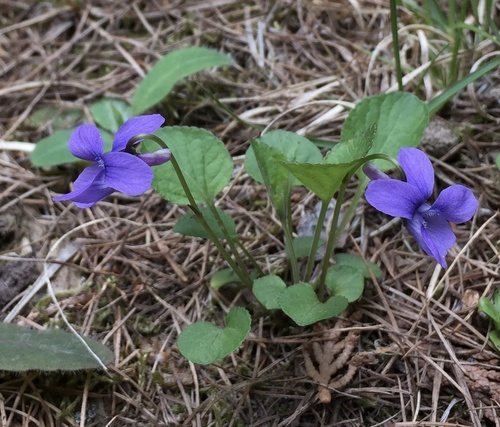
The Hookedspur Violet (Viola adunca) is a charming perennial wildflower that brightens North American landscapes with its vibrant purple hues. Found from subalpine meadows to coastal bluffs, this resilient little plant is celebrated for its delicate, heart-shaped leaves and distinctive spurred petals. It plays a critical role in its local ecosystems, acting as a primary larval host plant for several species of fritillary butterflies. Gardeners and nature enthusiasts alike cherish this violet for its early spring blooms, which signal the end of winter and the awakening of the wild.
Lebensraum: Typically found in open forests, moist meadows, grassy slopes, and coastal dunes across northern and western North America.
This compact herbaceous perennial typically grows between 5 to 15 centimeters tall, featuring small, heart-shaped or ovate leaves with finely scalloped edges. Its flowers are highly distinctive, displaying five violet-to-deep-blue petals; the lower three petals have white bases with dark purple veins that act as nectar guides for pollinators. The most defining feature is the prominent, backward-pointing spur at the rear of the flower, which is often noticeably hooked or curved at the tip, giving this species its common name.
Kategorie
PflanzenSeltenheit
Common
Gefahr
1/5 · Sehr gering
Snaps
Mach den ersten Snap!
Its leaves and flowers are rich in vitamins A and C and have historically been used in traditional herbal teas and salads.
The curved 'hook' behind the flower petal is actually a pocket containing nectar, accessible only to insects with long tongues.
This plant produces two types of flowers: showy ones in spring that require insect pollination, and closed, self-pollinating ones later in summer.
The mature seed pods of this violet dry out and contract unevenly, building up tension until they violently burst, launching seeds several feet away from the parent plant.
The seeds produce a lipid-rich structure called an elaiosome, which coaxes ants into carrying the seeds safely underground to their nests, aiding in propagation.
The delicate purple veins on its lower petals reflect ultraviolet light, creating a secret bullseye map that directs pollinating insects to the hidden nectar spur.
As a photosynthetic plant, the Hookedspur Violet synthesizes its own energy from sunlight, carbon dioxide, and soil nutrients.
Boloria selene
This violet acts as an essential larval host plant, providing nourishment for the hungry caterpillars of this butterfly.
Formica obscuripes
Ants carry the seeds back to their nests to eat the nutritious elaiosome, effectively planting the seeds in rich underground soil.
Für dieses Objekt sind noch keine Merkmal-Badges vergeben.
Noch keine Alternativnamen vorhanden.
Sammlungen für dieses Objekt erscheinen hier, wenn weitere Themen hinzugefügt werden.
Gefahr
1/5 · Sehr gering
Noch keine besonderen Sicherheitshinweise.
Der einfachste Weg, Hookedspur Violet zu bestimmen, ist die Verwendung der Naturführer-App Snappit.
5-15 cm
3-8 Jahre
As a photosynthetic plant, the Hookedspur Violet synthesizes its own energy from sunlight, carbon dioxide, and soil nutrients.
Typically found in open forests, moist meadows, grassy slopes, and coastal dunes across northern and western North America.
Zoome hinein, um Cluster aufzulösen und zu sehen, wo dieses Objekt fotografiert wurde.
Neueste Snaps erscheinen hier, wenn neue Beobachtungen hinzukommen.













.jpg&width=800)