

Hop Goodenia
goodenia ovata
The Hop Goodenia is a fast-growing, resilient shrub native to the damp forests and open woodlands of southeastern Australia. Reaching up to two meters in height, this vibrant plant is beloved for its bright yellow, fan-shaped flowers that bloom in abundance throughout most of the year. As a classic understorey species, it plays a vital role in local ecosystems by rapidly colonizing disturbed ground, stabilizing soil, and providing critical shelter for small bushland creatures. This adaptable nature makes it highly successful in both wild forests and urban native gardens. Historically, the plant has held cultural significance, with some Indigenous Australian communities utilizing its sedative properties. Today, it remains an essential component of local revegetation projects due to its hardiness and ability to rebound quickly after bushfires.
Lebensraum: Found in damp forests, wet sclerophyll woodlands, and riparian zones of southeastern Australia, often thriving in disturbed areas and along roadsides.
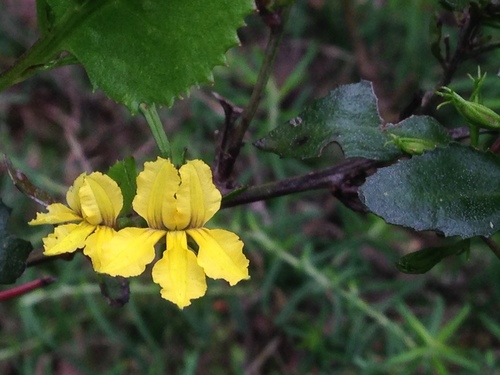
Hop Goodenia is a medium-sized shrub typically growing 1 to 2.5 meters tall, featuring an erect or spreading habit with glossy, bright green leaves. The leaves are ovate (oval-shaped), measuring 3 to 8 centimeters long, with finely serrated margins and a slightly sticky texture when young. Its most distinctive feature is its bright yellow flowers, which are about 1.5 to 2 centimeters across. These blossoms showcase an asymmetrical, fan-like structure with five petals split open on one side, arranged in small clusters in the leaf axils.
Kategorie
PflanzenSeltenheit
Common
Gefahr
1/5 · Sehr gering
Snaps
Mach den ersten Snap!
Historically, Indigenous Australians placed Hop Goodenia leaves in babies' bedding to help induce sleep due to the plant's mild sedative properties.
Its scientific name, Goodenia, honors the 18th-century English botanist and Bishop of Carlisle, Samuel Goodenough.
The common name 'Hop Goodenia' comes from the bitter taste of its leaves, which early European settlers compared to hops used in beer brewing.
The seeds of the Hop Goodenia can lie dormant in the soil for years, germinating rapidly after fire or soil disturbance to stabilize the landscape.
The plant utilizes a cup-like structure (indusium) on its style to capture and present pollen, ensuring efficient transfer to visiting insects.
Young leaves and stems produce a sticky resinous substance that helps deter herbivores and reduce water loss in warmer weather.
As a photosynthetic plant, the Hop Goodenia produces its own energy using sunlight, carbon dioxide, and water while drawing essential minerals from the soil.
Junonia villida
Larvae of the Meadow Argus butterfly feed extensively on the foliage of Hop Goodenia.
Amegilla cingulata
The bee visits the flowers for nectar and pollen, acting as an effective pollinator.
Für dieses Objekt sind noch keine Merkmal-Badges vergeben.
Noch keine Alternativnamen vorhanden.
Sammlungen für dieses Objekt erscheinen hier, wenn weitere Themen hinzugefügt werden.
Gefahr
1/5 · Sehr gering
Noch keine besonderen Sicherheitshinweise.
Der einfachste Weg, Hop Goodenia zu bestimmen, ist die Verwendung der Naturführer-App Snappit.
100-250 cm
5-15 Jahre
As a photosynthetic plant, the Hop Goodenia produces its own energy using sunlight, carbon dioxide, and water while drawing essential minerals from the soil.
Found in damp forests, wet sclerophyll woodlands, and riparian zones of southeastern Australia, often thriving in disturbed areas and along roadsides.
Zoome hinein, um Cluster aufzulösen und zu sehen, wo dieses Objekt fotografiert wurde.
Neueste Snaps erscheinen hier, wenn neue Beobachtungen hinzukommen.