

Iberian Fritillary
fritillaria lusitanica
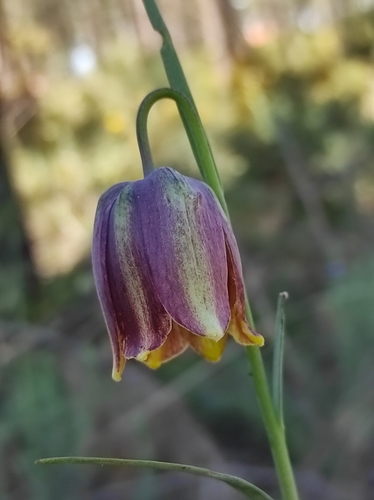
The Iberian Fritillary (Fritillaria lusitanica) is an enchanting perennial wildflower endemic to the Iberian Peninsula. Belonging to the lily family (Liliaceae), it is celebrated for its distinctive bell-shaped, nodding flowers that dangle gracefully from slender stems. This resilient plant flourishes in Mediterranean climates, springing to life from underground bulbs to paint rocky hillsides and open pine woods with its earthy, complex hues. Often overlooked due to its subtle coloration, it remains a highly prized find for botanists and hikers exploring the rugged landscapes of Spain and Portugal.
Lebensraum: Typically found in dry, rocky grasslands, open pine forests, and Mediterranean scrublands across Spain and Portugal.
This species typically grows between 10 to 50 cm tall, featuring narrow, linear, grey-green leaves arranged alternately along a slender, upright stem. The single, terminal flower is a bell-shaped, nodding blossom measuring 2 to 3 cm long. Its petals display a variable coloration of purplish-brown, chocolate, or deep bronze, frequently accented with a yellowish-green stripe down the center or a subtle checkered pattern, while the inside reveals a brighter greenish-yellow hue.
Kategorie
PflanzenSeltenheit
Common
Gefahr
1/5 · Sehr gering
Snaps
Mach den ersten Snap!
The color of its petals can be highly variable, ranging from deep chocolate purple to lighter greenish-yellow, sometimes making it challenging for amateur botanists to identify.
The genus name Fritillaria comes from the Latin word 'fritillus', meaning dice-box, referring to the checkered markings typical of many species in this genus.
This species is highly adapted to wildfire-prone Mediterranean environments, with underground bulbs safely insulated from surface heat.
Survives the dry, harsh Mediterranean summers by retreating into an underground bulb that stores water and nutrients.
The downward-facing, bell-shaped flowers protect delicate reproductive organs from rain and prevent pollen from being washed away.
Forms symbiotic relationships with underground fungi to maximize nutrient absorption from nutrient-poor rocky soils.
As a photosynthetic plant, the Iberian Fritillary produces its own energy using sunlight, water, and carbon dioxide.
Bombus terrestris
Visits the nodding flowers to feed on nectar, assisting in cross-pollination.
Lilioceris lilii
Larvae and adults feed heavily on the leaves and buds, potentially defoliating the plant.
Für dieses Objekt sind noch keine Merkmal-Badges vergeben.
Noch keine Alternativnamen vorhanden.
Sammlungen für dieses Objekt erscheinen hier, wenn weitere Themen hinzugefügt werden.
Gefahr
1/5 · Sehr gering
Noch keine besonderen Sicherheitshinweise.
Der einfachste Weg, Iberian Fritillary zu bestimmen, ist die Verwendung der Naturführer-App Snappit.
10-50 cm
0.01-0.05 kg
5-15 Jahre
As a photosynthetic plant, the Iberian Fritillary produces its own energy using sunlight, water, and carbon dioxide.
Typically found in dry, rocky grasslands, open pine forests, and Mediterranean scrublands across Spain and Portugal.
20-80
Zoome hinein, um Cluster aufzulösen und zu sehen, wo dieses Objekt fotografiert wurde.
Neueste Snaps erscheinen hier, wenn neue Beobachtungen hinzukommen.