

Indian Rushpea
hoffmannseggia glauca
The Indian Rushpea (Hoffmannseggia glauca), also commonly known as hogpotato, is a resilient perennial herb native to the arid and semi-arid regions of the southwestern United States and northern Mexico. Belonging to the pea family (Fabaceae), this low-growing plant is famous for its nutritious underground tubers, which resemble tiny potatoes and were historically harvested as a valuable food source by indigenous peoples, including the Navajo and Apache. It thrives in harsh, dry environments where few other plants can survive, utilizing a deep, creeping root system to anchor itself and store moisture. Though it is sometimes considered an agricultural weed due to its aggressive spread, the Indian Rushpea plays an important role in its native ecosystem, stabilizing sandy soils and providing food for various local wildlife species.
Lebensraum: Typically found in dry, sandy, or clay soils, often in alkaline flats, desert grasslands, and disturbed roadsides across arid regions.
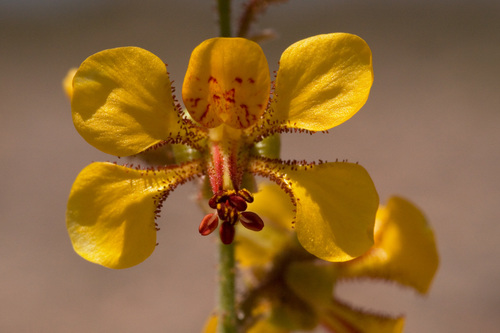
This herb typically grows low to the ground, reaching heights of 10 to 30 centimeters. It features pale, dusty-green bipinnate leaves that resemble miniature fern fronds or mesquite leaves. During its blooming period from spring to summer, it produces small, upright clusters of attractive yellow flowers. Each flower has five petals, often adorned with tiny, glandular red dots or streaks, and orange-red stamens that protrude from the center. The seed pods are flat, slightly curved, and turn a brownish color as they mature, hanging conspicuously from the stems.
Kategorie
PflanzenSeltenheit
Common
Gefahr
1/5 · Sehr gering
Snaps
Mach den ersten Snap!
Historically, Native American tribes roasted the sweet-tasting tubers or ground them into flour for nutritional sustenance.
Its deep and creeping root system can extend several feet underground, making it incredibly difficult to remove once established in agricultural fields.
The common name 'hogpotato' comes from the small, underground tubers which pigs and other animals eagerly dig up and eat.
The plant develops swelling nodes or tubers on its roots that store water and nutrients, enabling it to survive long periods of extreme drought.
Like other members of the legume family, it partners with soil bacteria to convert atmospheric nitrogen into a usable nutrient form.
Its stems, leaves, and flowers are covered in tiny, sticky glandular hairs that deter hungry insects and reduce water loss.
Synthesizes its own energy from sunlight, water, and carbon dioxide through photosynthesis, assisted by root nodules that fix nitrogen.
Thomomys bottae
The underground tubers are dug up and eaten by pocket gophers.
Megachile rotundata
The flowers are visited and pollinated by native bees looking for nectar.
Bos taurus
Provides occasional forage for livestock, though sometimes considered a nuisance weed in pastures.
Für dieses Objekt sind noch keine Merkmal-Badges vergeben.
Noch keine Alternativnamen vorhanden.
Sammlungen für dieses Objekt erscheinen hier, wenn weitere Themen hinzugefügt werden.
Gefahr
1/5 · Sehr gering
Noch keine besonderen Sicherheitshinweise.
Der einfachste Weg, Indian Rushpea zu bestimmen, ist die Verwendung der Naturführer-App Snappit.
10-30 cm
0.01-0.05 kg
3-10 Jahre
Synthesizes its own energy from sunlight, water, and carbon dioxide through photosynthesis, assisted by root nodules that fix nitrogen.
Typically found in dry, sandy, or clay soils, often in alkaline flats, desert grasslands, and disturbed roadsides across arid regions.
Zoome hinein, um Cluster aufzulösen und zu sehen, wo dieses Objekt fotografiert wurde.
Neueste Snaps erscheinen hier, wenn neue Beobachtungen hinzukommen.