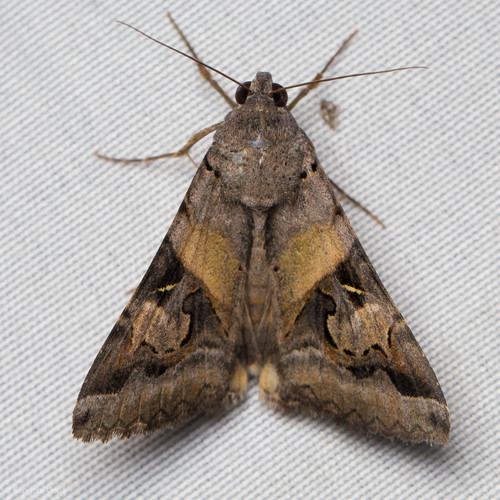


Indomitable Graphic Moth
melipotis indomita
The Indomitable Graphic Moth (Melipotis indomita) is a striking member of the Erebidae family, renowned for the bold, geometric patterns on its wings. Found primarily in arid and semi-arid regions where its host plants thrive, this resilient insect showcases nature's incredible capacity for contrast and camouflage. While resting, its intricate forewing patterns blend seamlessly with rough tree bark, protecting it from sharp-eyed predators. As a nocturnal species, this moth plays a vital role in local ecosystems as a nocturnal pollinator and a key food source for bats and insectivorous birds. Its larvae are specialized feeders, tightly linked to the survival of native mesquite trees. Observing one of these moths up close reveals a masterclass in natural graphic design, making it a highly rewarding find for nature enthusiasts exploring the nocturnal world.
Lebensraum: Found in arid scrublands, riparian woodlands, and suburban gardens, closely associated with native mesquite and acacia trees.
The Indomitable Graphic Moth features a wingspan of 4 to 5 centimeters. Its forewings are decorated with a dramatic, high-contrast mosaic of dark charcoal gray, warm brown, and pale cream bands that form sharp, angular geometric patterns. In stark contrast, the hindwings, which are typically hidden when at rest, are dark blackish-brown with a brilliant white patch or band running through the center. Its robust body is mottled gray, and its antennae are fine and thread-like, characteristic of erebid moth species.
Kategorie
InsektenSeltenheit
Common
Gefahr
1/5 · Sehr gering
Snaps
Mach den ersten Snap!
Because their caterpillars feed heavily on mesquite, they play a minor role in regulating the growth of this sometimes invasive rangeland shrub.
Despite its fragile appearance, the moth is named 'indomita' due to its high resilience and ability to survive in harsh, arid desert conditions.
The striking white-and-black pattern on its hindwing is only visible during flight, acting as an 'air-brake' flash to confuse pursuing birds.
When resting on tree trunks, the intricate, broken patterns on its forewings disrupt its outline, making it virtually invisible against rough bark.
When startled, it quickly opens its wings to reveal the bright white bands on its dark hindwings, a sudden contrast designed to startle and confuse predators.
Possesses sensitive tympanic organs on its metathorax that can detect the high-frequency echolocation calls of hunting bats, allowing it to perform evasive aerial maneuvers.
Caterpillars feed exclusively on the foliage of woody legumes like mesquite, while adult moths feed on nectar and plant exudates.
Altersunterschiede: Larvae chew solid foliage of mesquite trees, whereas adults possess a proboscis to sip liquid nectar and sap.
Prosopis glandulosa
The primary larval host plant where females lay eggs and caterpillars feed.
Eptesicus fuscus
An insectivorous predator that actively hunts adult moths at night using echolocation.
Sialia mexicana
A common avian predator that searches tree bark during the day to feed on resting moths.
Für dieses Objekt sind noch keine Merkmal-Badges vergeben.
Noch keine Alternativnamen vorhanden.
Sammlungen für dieses Objekt erscheinen hier, wenn weitere Themen hinzugefügt werden.
Gefahr
1/5 · Sehr gering
Noch keine besonderen Sicherheitshinweise.
Der einfachste Weg, Indomitable Graphic Moth zu bestimmen, ist die Verwendung der Naturführer-App Snappit.
2-3 cm
4-5 cm
0.0001-0.0003 kg
0 Jahre
15 km/h
Caterpillars feed exclusively on the foliage of woody legumes like mesquite, while adult moths feed on nectar and plant exudates.
Found in arid scrublands, riparian woodlands, and suburban gardens, closely associated with native mesquite and acacia trees.
Zoome hinein, um Cluster aufzulösen und zu sehen, wo dieses Objekt fotografiert wurde.
Neueste Snaps erscheinen hier, wenn neue Beobachtungen hinzukommen.


















