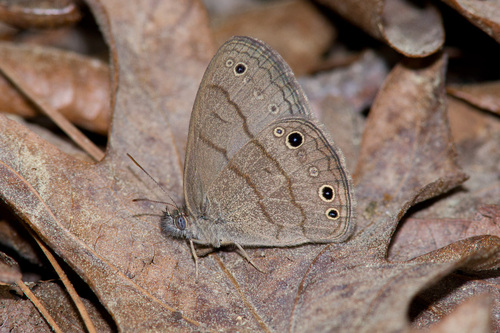


Intricate Satyr
hermeuptychia intricata
The Intricate Satyr, scientific name Hermeuptychia intricata, is a small and rather inconspicuous butterfly belonging to the Nymphalidae family, commonly known as brush-footed butterflies. It is renowned for its subtle yet complex beauty, primarily expressed through the detailed patterns on its underwings, which serve as remarkable camouflage. Often found flitting through the undergrowth of various forested habitats, this species plays a role in its ecosystem as both a pollinator and a food source for other creatures. Despite its delicate appearance, the Intricate Satyr is a resilient insect, perfectly adapted to its environment, offering a quiet charm to those who take the time to observe its intricate details.
Lebensraum: Found in various types of woodlands, forest edges, and grassy clearings within forested areas, often close to the ground among undergrowth.
The Intricate Satyr is a small butterfly with a typical forewing length ranging from 1.5 to 2.5 centimeters. The upperside of its wings is generally a dull, uniform brown. However, its most distinctive features are found on the underside of both the forewings and hindwings, which display a complex tapestry of thin, wavy lines and bands in shades of brown, tan, and creamy white. Usually, two small, dark eyespots, often ringed with pale yellow and a metallic pupil, are visible on the hindwing underside. The wing margins can appear slightly scalloped, adding to its natural camouflage.
Kategorie
InsektenSeltenheit
Common
Gefahr
1/5 · Sehr gering
Snaps
Mach den ersten Snap!
Distinguishing the Intricate Satyr from closely related species, such as the Little Wood-Satyr (Megisto cymela), can be quite challenging due to their very similar appearances and overlapping habitats.
Like many satyr butterflies, the Intricate Satyr typically flies low to the ground, often among grasses and undergrowth, rarely venturing high into the air.
The genus name 'Hermeuptychia' is thought to be derived from Greek mythology, though 'intricata' directly refers to the complex and detailed patterns found on its wings.
The small 'eyespots' on the hindwings are believed to serve as a defense mechanism, deterring predators by drawing attention away from the butterfly's vital body parts and acting as a false target.
The intricate patterns on the butterfly's wing undersides are highly mimetic of dead leaves, bark, or dry grass, allowing it to blend seamlessly into its environment when at rest, making it incredibly difficult for predators to spot.
Its flight is typically low, weak, and bouncy, creating an unpredictable movement that can make it appear less like a viable meal to avian predators and more like a drifting leaf or debris.
Adults are adept at extracting moisture and essential nutrients from less obvious sources such as dew drops, damp soil (mud-puddling), or decaying fruit, which allows them to persist in conditions where fresh nectar might be scarce.
Larval Intricate Satyrs feed exclusively on various grasses. Adult butterflies primarily sustain themselves by consuming nectar from a range of flowering plants, often including less conspicuous species, and can also obtain nutrients from decaying fruit or moist soil.
Altersunterschiede: Yes, larvae feed on grasses, while adults primarily feed on nectar and other liquids.
Poaceae (family)
Primary larval food source, providing nutrition for growth and development.
Polistes dominula
Predation on adult butterflies by generalist insect predators.
Geranium maculatum
Adult butterflies feed on its nectar, contributing to pollination.
Für dieses Objekt sind noch keine Merkmal-Badges vergeben.
Noch keine Alternativnamen vorhanden.
Sammlungen für dieses Objekt erscheinen hier, wenn weitere Themen hinzugefügt werden.
Gefahr
1/5 · Sehr gering
Noch keine besonderen Sicherheitshinweise.
Der einfachste Weg, Intricate Satyr zu bestimmen, ist die Verwendung der Naturführer-App Snappit.
1-2 cm
3-4 cm
0.0001-0.0003 kg
0 Jahre
10 km/h
Larval Intricate Satyrs feed exclusively on various grasses. Adult butterflies primarily sustain themselves by consuming nectar from a range of flowering plants, often including less conspicuous species, and can also obtain nutrients from decaying fruit or moist soil.
Found in various types of woodlands, forest edges, and grassy clearings within forested areas, often close to the ground among undergrowth.
Zoome hinein, um Cluster aufzulösen und zu sehen, wo dieses Objekt fotografiert wurde.
Neueste Snaps erscheinen hier, wenn neue Beobachtungen hinzukommen.
















