

Kanawha Blackbelly Salamander
desmognathus kanawha
The Kanawha Blackbelly Salamander (Desmognathus kanawha) is a fascinating amphibian endemic to the pristine stream systems of West Virginia. This species belongs to the 'dusky salamander' group, known for their robust build and semi-aquatic lifestyles. They are an integral part of their forest and stream ecosystems, serving as both predators of small invertebrates and prey for larger animals. Their presence is often indicative of good water quality and healthy riparian habitats. Though relatively small, these salamanders possess remarkable adaptations, including parental care for their eggs and the ability to thrive in the interface between land and water, making them resilient inhabitants of their specific niches in the Appalachian Mountains.
Lebensraum: The Kanawha Blackbelly Salamander inhabits cool, clear headwater streams, springs, and moist seeps within forested mountain regions, often found under rocks, logs, and leaf litter at the water's edge.
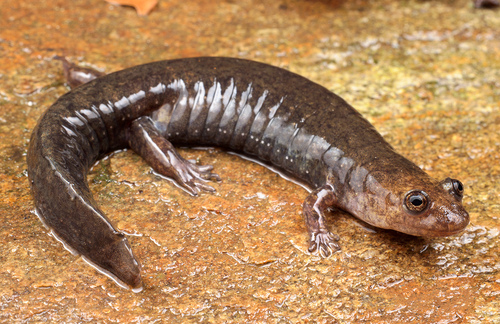
This species typically presents a stout, robust body with strong limbs. Its dorsal coloration can vary, often appearing dark brown to black, sometimes with lighter mottling or a reddish-brown hue along the flanks. The most distinctive feature, as its name suggests, is a generally dark or black ventral side, which can help differentiate it from other sympatric salamander species. Adults usually measure between 8 to 14 centimeters in total length, possessing a moderately sized head and a tail that is often keeled.
Kategorie
AmphibienSeltenheit
Common
Gefahr
1/5 · Sehr gering
Snaps
Mach den ersten Snap!
Despite its name, the blackbelly coloration can vary, sometimes appearing mottled or with a faint pattern depending on the individual and local population.
During dry periods, these salamanders may burrow deep into leaf litter or soil to find moisture, demonstrating their adaptability to fluctuating environmental conditions.
Like many plethodontid salamanders, the Kanawha Blackbelly Salamander lacks lungs and respires entirely through its skin and the lining of its mouth.
They are excellent indicators of stream health, as their sensitive skin and specific habitat requirements mean they thrive only in clean, unpolluted waters.
Many Desmognathus species, including those closely related to D. kanawha, bypass a free-swimming larval stage, hatching directly into miniature adults. This reduces vulnerability to aquatic predators.
Female Kanawha Blackbelly Salamanders exhibit parental care by coiling around and guarding their clutch of eggs, protecting them from predators and desiccation until they hatch.
When threatened, this salamander can shed its tail as a distraction to escape predators. The detached tail can continue to wriggle, providing a diversion while the salamander flees to safety.
The Kanawha Blackbelly Salamander is a carnivorous insectivore, feeding primarily on a variety of small invertebrates found in and around its stream habitat. It plays a role in controlling local insect populations.
Plecoptera (larvae)
Main food source, especially larval forms.
Nerodia sipedon
Common predator in their habitat.
Desmognathus fuscus
Common competitor for food resources and microhabitat.
Acer/Fagus spp. (deadwood)
Serves as a critical microhabitat and foraging ground.
Für dieses Objekt sind noch keine Merkmal-Badges vergeben.
Noch keine Alternativnamen vorhanden.
Sammlungen für dieses Objekt erscheinen hier, wenn weitere Themen hinzugefügt werden.
Gefahr
1/5 · Sehr gering
Noch keine besonderen Sicherheitshinweise.
Der einfachste Weg, Kanawha Blackbelly Salamander zu bestimmen, ist die Verwendung der Naturführer-App Snappit.
8-14 cm
0.003-0.008 kg
5-10 Jahre
The Kanawha Blackbelly Salamander is a carnivorous insectivore, feeding primarily on a variety of small invertebrates found in and around its stream habitat. It plays a role in controlling local insect populations.
The Kanawha Blackbelly Salamander inhabits cool, clear headwater streams, springs, and moist seeps within forested mountain regions, often found under rocks, logs, and leaf litter at the water's edge.
Ambush
10-25
Zoome hinein, um Cluster aufzulösen und zu sehen, wo dieses Objekt fotografiert wurde.
Neueste Snaps erscheinen hier, wenn neue Beobachtungen hinzukommen.