

Kidney-Leaved Grass Of Parnassus
parnassia asarifolia
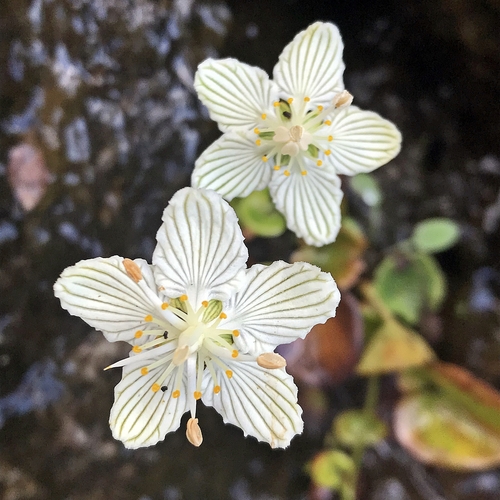
Kidney-Leaved Grass of Parnassus (Parnassia asarifolia) is an elegant, perennial wildflower native to the damp, montane wetlands of the eastern United States, particularly within the Appalachian region. Despite its common name, it is not a true grass but rather a member of the Celastraceae family. It is celebrated by botanists and nature enthusiasts for its striking, solitary white flowers, which sit atop slender stems and feature intricate, translucent green veining that guides pollinators to its center. The plant thrives in nutrient-poor, saturated soils where competition is low but survival demands specialized adaptations. Its lush, glossy, kidney-shaped basal leaves closely resemble those of wild ginger, giving the plant its specific epithet, asarifolia. Finding this delicate beauty in a bog or seep is a highlight for any wetland explorer, signifying a high-quality, undisturbed natural habitat.
Lebensraum: Found in high-elevation seepages, bogs, fens, and wet stream banks, typically within acidic, saturated soils of the Appalachian region.
This plant is easily identified by its single, five-petaled white flower, roughly 2 to 3 centimeters across, decorated with distinctive, prominent greenish-yellow veins radiating from the base of each petal. The petals surround five fertile stamens alternating with sterile, branched gland-tipped structures called staminodes. A single leaf-like bract clasps the stem about midway up. At the base of the plant, a rosette of glossy, long-stalked, kidney-shaped leaves, measuring 3 to 10 centimeters wide, rests close to the ground. The upright flowering stems can reach heights of 15 to 50 centimeters.
Kategorie
PflanzenSeltenheit
Common
Gefahr
1/5 · Sehr gering
Snaps
Mach den ersten Snap!
Its species name, asarifolia, means 'leaves like Asarum,' referring to the striking resemblance of its foliage to that of wild ginger.
The glistening droplets on the sterile stamens look like fresh, sugary nectar to insects, but they are actually dry, solid structures designed to deceive pollinators.
The name Grass of Parnassus is a double misnomer: it is not a grass, and while the genus is named after Greece's Mount Parnassus, this specific species is native solely to North America.
The flower produces glistening, sterile stamens tipped with yellow knobs that mimic nectar droplets to lure pollinators without expending energy to produce excess nectar.
Its ground-hugging, kidney-shaped basal leaves efficiently capture sunlight filtering through sparse wetland canopies while maximizing moisture absorption.
A specialized root system allows the plant to thrive in highly acidic, waterlogged, and oxygen-depleted bog environments where other plants suffocate.
Synthesizes energy from sunlight via photosynthesis, while drawing water and essential minerals from acidic, waterlogged soils.
Syrphus ribesii
Pollinates the flowers, drawn in by the deceptive, glistening sterile staminodes.
Sphagnum palustre
Often grows in close association with this moss, which helps create the acidic, moist microhabitat necessary for seed germination.
Odocoileus virginianus
Occasionally browses on the foliage and flowering stems in wetland habitats.
Für dieses Objekt sind noch keine Merkmal-Badges vergeben.
Noch keine Alternativnamen vorhanden.
Sammlungen für dieses Objekt erscheinen hier, wenn weitere Themen hinzugefügt werden.
Gefahr
1/5 · Sehr gering
Noch keine besonderen Sicherheitshinweise.
Der einfachste Weg, Kidney-Leaved Grass Of Parnassus zu bestimmen, ist die Verwendung der Naturführer-App Snappit.
15-50 cm
3-10 Jahre
Synthesizes energy from sunlight via photosynthesis, while drawing water and essential minerals from acidic, waterlogged soils.
Found in high-elevation seepages, bogs, fens, and wet stream banks, typically within acidic, saturated soils of the Appalachian region.
Zoome hinein, um Cluster aufzulösen und zu sehen, wo dieses Objekt fotografiert wurde.
Neueste Snaps erscheinen hier, wenn neue Beobachtungen hinzukommen.











