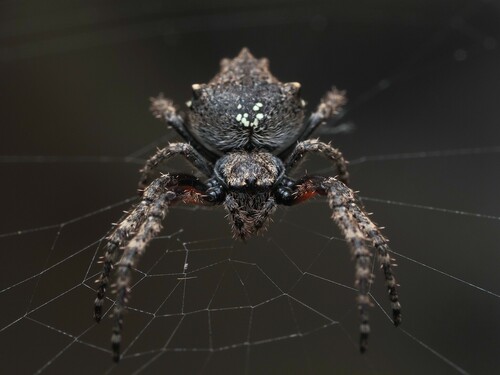


Knobbled Orbweaver
socca pustulosa
The Knobbled Orbweaver (Socca pustulosa) is a highly adaptable spider found abundantly across Australia and New Zealand. Renowned for its intricate, classic circular webs, this nocturnal arachnid plays a vital role in controlling insect populations in both natural forests and suburban gardens. During the day, it exhibits an impressive display of camouflage, pulling its legs tightly against its body and resting on bark or foliage where it blends in seamlessly as a piece of debris or lichen. At night, it becomes an active architect, spinning a fresh orb web to snare flying prey. Highly variable in color and patterning, each individual displays a unique aesthetic. Its resilience and cohabitation with humans make it one of the most frequently encountered spiders in backyard settings, serving as a harmless and highly beneficial natural pest controller.
Lebensraum: Typically found in coastal forests, open woodlands, suburban gardens, and parks, often suspended between shrubs or tree branches.
This small-to-medium spider is characterized by a roughly triangular abdomen featuring five distinct bumps or 'knobbles' on its posterior end. Their coloration is incredibly diverse, ranging from mottled grey and dark brown to light green, yellow, or white, often mimicry-designed to look like bark, lichen, or bird droppings. Females are notably larger than males, measuring up to 1.5 cm in body length, while males rarely exceed 0.8 cm. When resting during the day, they tuck their spiny legs tightly against their body, making their characteristic abdomen shape the most prominent identifier.
Kategorie
InvertebrateSeltenheit
Common
Gefahr
1/5 · Sehr gering
Snaps
Mach den ersten Snap!
The five distinct 'knobs' on its abdomen give the spider its common name and help break up its silhouette to fool predators.
They spin their webs in the evening and almost completely dismantle and eat them at dawn to prevent wastage of energy and valuable silk proteins.
This spider's coloration is so highly variable that two individuals of the same species found in the same garden can look entirely different.
This spider consumes its entire web each morning to recycle the silk proteins, then spins a brand-new web every night.
It can compress its body and tuck its legs to perfectly resemble a piece of lichen, bark, or bird dropping to evade daytime predators.
Utilizes specialized glands to produce multiple distinct types of silk, tailored for structural support, sticky prey capture, or soft egg sac insulation.
Feeds primarily on flying insects intercepted by its vertical, sticky orb webs at night.
Altersunterschiede: Juveniles eat smaller insects like gnats and aphids, while adults target larger prey like moths and beetles.
Tineola bisselliella
Captured in flight by the spider's sticky nocturnal orb web.
Priocnemis monachus
Hunted by this specialized spider-wasp, which paralyzes the spider to provision its mud nest.
Gymnorhina tibicen
An opportunistic avian predator that plucks the spider from its daytime resting spot or night web.
Für dieses Objekt sind noch keine Merkmal-Badges vergeben.
Sammlungen für dieses Objekt erscheinen hier, wenn weitere Themen hinzugefügt werden.
Gefahr
1/5 · Sehr gering
Noch keine besonderen Sicherheitshinweise.
Der einfachste Weg, Knobbled Orbweaver zu bestimmen, ist die Verwendung der Naturführer-App Snappit.
0+ cm
0+ kg
1+ Jahre
Feeds primarily on flying insects intercepted by its vertical, sticky orb webs at night.
Typically found in coastal forests, open woodlands, suburban gardens, and parks, often suspended between shrubs or tree branches.
Ambush
Zoome hinein, um Cluster aufzulösen und zu sehen, wo dieses Objekt fotografiert wurde.
Neueste Snaps erscheinen hier, wenn neue Beobachtungen hinzukommen.