

Large-Flowered Tomatillo
physalis philadelphica
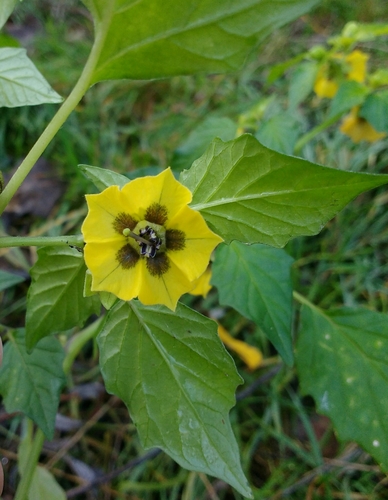
The Large-Flowered Tomatillo (Physalis philadelphica) is a sprawling annual plant in the nightshade family, highly esteemed as the primary ingredient in traditional Mexican green salsas. Originating in Mesoamerica, it was a staple crop for the Aztecs and Mayans long before the familiar red tomato took the global stage. It is easily recognized by its remarkable fruit, which grows encased in a papery, lantern-like husk formed from the plant's calyx. Beyond its culinary significance, this hardy plant is an adaptable pioneer species. It readily establishes itself in disturbed soils, agricultural fields, and garden plots. The plant features broad leaves and striking yellow flowers with dark centers that attract a wide variety of native bees. As it grows, it forms a dense, bushy habit that protects its developing husks and provides minor shelter for ground-dwelling insects.
Lebensraum: Typically found in agricultural fields, disturbed soils, roadsides, and cultivated gardens with plenty of sunlight and well-draining soil.
Physalis philadelphica is an erect or sprawling annual herbaceous plant that typically reaches 60 to 120 centimeters in height. Its stems are somewhat succulent, bearing alternate, ovate to lanceolate leaves with irregularly toothed edges. The most distinguishing visual feature is its reproductive structure: beautiful, star-shaped yellow flowers with distinctive dark purple or brown markings radiating from the center. Following successful pollination, the flower's calyx dramatically expands into a pale green, papery, lantern-like husk that completely envelops the developing spherical berry. As the fruit matures, it fills the husk, eventually causing the papery covering to split and reveal the firm, sticky, green or purplish fruit inside.
Kategorie
PflanzenSeltenheit
Common
Gefahr
1/5 · Sehr gering
Snaps
Mach den ersten Snap!
Because tomatillo plants are highly self-incompatible, you must plant at least two of them near each other to produce any fruit.
The papery husk surrounding a tomatillo is actually an enlarged calyx, which is the part of the flower that originally protected the bud.
The sticky residue found on the skin of the fruit underneath the husk contains natural insect-deterrent compounds.
Tomatillos were cultivated by the Aztecs and Mayans centuries before the familiar red tomato became a staple crop.
The enlarged papery husk physically shields the growing fruit from excessive sun, insect damage, and harsh weather conditions.
The plant requires cross-pollination from a genetically distinct neighbor to set fruit, promoting genetic diversity.
Deep taproots and somewhat waxy foliage allow the plant to tolerate extended dry spells in semi-arid environments.
As a photosynthetic plant, it relies on sunlight to produce its own energy from carbon dioxide and water.
Apis mellifera
Pollinates the large yellow flowers.
Lema daturaphila
Feeds destructively on the foliage.
Mimus polyglottos
Consumes fallen fruit and disperses seeds.
Für dieses Objekt sind noch keine Merkmal-Badges vergeben.
Noch keine Alternativnamen vorhanden.
Sammlungen für dieses Objekt erscheinen hier, wenn weitere Themen hinzugefügt werden.
Gefahr
1/5 · Sehr gering
Noch keine besonderen Sicherheitshinweise.
Der einfachste Weg, Large-Flowered Tomatillo zu bestimmen, ist die Verwendung der Naturführer-App Snappit.
60-120 cm
1 Jahre
As a photosynthetic plant, it relies on sunlight to produce its own energy from carbon dioxide and water.
Typically found in agricultural fields, disturbed soils, roadsides, and cultivated gardens with plenty of sunlight and well-draining soil.
100-200
7-14 Tage
Zoome hinein, um Cluster aufzulösen und zu sehen, wo dieses Objekt fotografiert wurde.
Neueste Snaps erscheinen hier, wenn neue Beobachtungen hinzukommen.














