.jpg&width=800)





Large-leaved lupine
Lupinus polyphyllus
Large-leaved lupine is a colorful flower that grows in big clusters. Its leaves are wide and can look like a hand with many fingers. These flowers are great for gardens and attract butterflies!
Lebensraum: Grasslands
The Large-leaved lupine has tall, stately spires of densely packed, pea-like flowers, typically in shades of purple, blue, pink, or white. Its large, palmate leaves are divided into 9-17 leaflets, resembling a fan, often with a silvery underside.
Kategorie
PflanzenSeltenheit
Common
Gefahr
1/5 · Sehr gering
Snaps
Mach den ersten Snap!
Its seed pods can explosively twist open, flinging seeds like tiny rockets!
Lupine flowers on a spike often bloom from the bottom upwards!
Sometimes, this plant is called 'quaker bonnets' because of its flower shape!
The name 'lupine' comes from 'lupus,' the Latin word for wolf!
Large-leaved lupine can team up with tiny soil bacteria to grab nitrogen from the air, enriching the ground for itself and neighbors.
Large-leaved lupine has special chemicals called alkaloids in its seeds and leaves that protect it from hungry animals.
Large-leaved lupine has a long, strong taproot that can reach deep underground to find water, helping it survive drier times.
Bombus mixtus
Feeds on nectar and collects pollen from flowers.
Rhizobium leguminosarum
Lives in root nodules, converting atmospheric nitrogen for the plant.
Cervus canadensis
Browses on foliage and flowers, especially when other forage is scarce.
Peromyscus maniculatus
Consumes the seeds from the plant's pods.
Blütenpflanzen sind alle Pflanzen, die als Teil ihres Fortpflanzungszyklus Blüten bilden.
Beschreibt Organismen, die in der Lage sind, atmosphärischen Stickstoff in für Pflanzen nutzbare Verbindungen umzuwandeln.
Blütenbüschel sind Blütenstände, bei denen einzelne Blüten dicht beieinander an einem gemeinsamen Stängel angeordnet sind.
Frühlingsblüher bilden ihre Blüten im Frühjahr und kündigen oft das Ende des Winters und den Beginn neuen Wachstums an.

Heilpflanzen besitzen chemische Verbindungen, die für therapeutische Zwecke zur Behandlung von Krankheiten oder zur Erhaltung der Gesundheit eingesetzt werden können.

Beschreibt Pflanzen, die für eine Vielzahl von bestäubenden Organismen besonders attraktiv und nützlich sind.

Farbenfroh beschreibt Organismen oder Objekte, die eine große Vielfalt an leuchtenden und deutlich erkennbaren Farben aufweisen.

Grasland-Lebensräume sind terrestrische Biome, die von Gräsern und krautigen Pflanzen dominiert werden und einer Vielzahl von Weidetieren als Lebensraum dienen.
Noch keine Alternativnamen vorhanden.
Gefahr
1/5 · Sehr gering
Always look but don't touch wild flowers, as some might not be safe.
60-150 cm
60-90 cm
1-2 cm
Sommer
Nein
Leicht
Mehrjährig
Insekten
Zoome hinein, um Cluster aufzulösen und zu sehen, wo dieses Objekt fotografiert wurde.
Neueste Snaps erscheinen hier, wenn neue Beobachtungen hinzukommen.

Washington, US
Hier kann man sehen Bigleaf Maple, Common Snowberry und Osoberry.
Führer anzeigen →
Washington, US
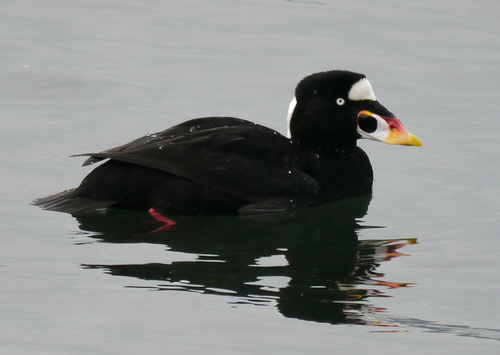
Hier kann man sehen Surf Scoter, Eastern Cottontail und Wildrose.
Führer anzeigen →

Washington, US
Hier kann man sehen California Bumble Bee und Yellow-Faced Bumble Bee.
Führer anzeigen →
British Columbia, CA
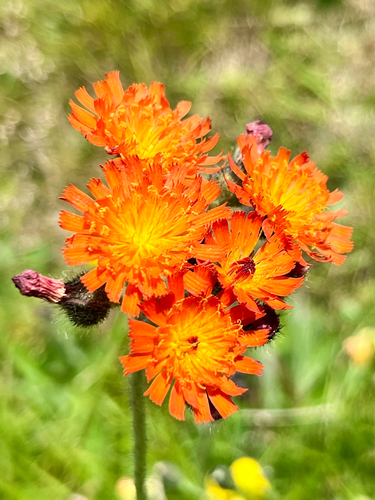
Hier kann man sehen Orange Hawkweed, Shinyleaf Meadowsweet und Columbia Lily.
Führer anzeigen →