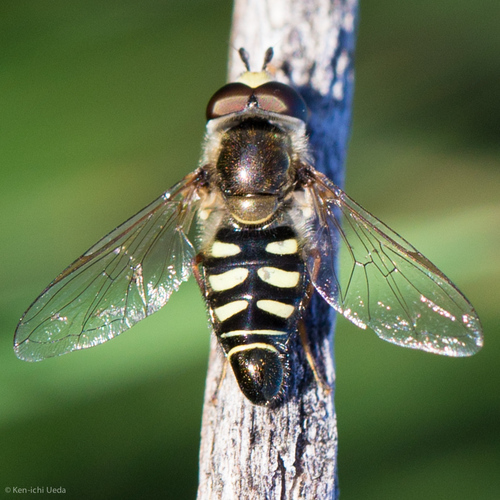


Large-Tailed Aphideater
eupeodes volucris
The Large-Tailed Aphideater (Eupeodes volucris) is a fascinating species of hoverfly well-known for its dual role as a master pollinator and a natural pest controller. At first glance, this nimble insect might be mistaken for a stinging wasp or bee due to its striking black-and-yellow patterned abdomen. However, it is completely harmless to humans. It gets its dramatic common name from the bulbous, prominent reproductive structures on the male's posterior, as well as the voracious, aphid-hunting lifestyle of its larval stage. These hoverflies are vital components of their ecosystems across North America. While the adults spend their days zipping from flower to flower drinking nectar and transferring pollen, the slug-like larvae act as relentless predators, silently sweeping through gardens and agricultural fields to devour thousands of aphids. This makes the Large-Tailed Aphideater a highly valued ally for farmers and gardeners alike, beautifully bridging the gap between pest management and plant reproduction.
Lebensraum: Typically found in open gardens, sunny meadows, agricultural fields, and woodland edges where flowering plants and aphid colonies are abundant.
The Large-Tailed Aphideater is a moderately sized hoverfly reaching about 7 to 11 millimeters in length. It features a predominantly black abdomen punctuated by three pairs of distinctive pale yellow to whitish crescent-shaped spots, or lunules, that do not quite reach the side margins of its body. The thorax is a metallic greenish-bronze, bearing a pair of large, reddish-brown compound eyes that meet at the top of the head in males but remain separated in females. Males are specifically distinguished by unusually large, rounded terminalia at the end of the abdomen, giving them a recognizable 'large-tailed' appearance. Their single pair of transparent wings rest flat over the back when the insect is stationary.
Kategorie
InsektenSeltenheit
Common
Gefahr
1/5 · Sehr gering
Snaps
Mach den ersten Snap!
A single Large-Tailed Aphideater larva can devour up to 400 aphids during its two-week developmental phase, piercing them with specialized mouthparts to drain their fluids.
Adults can beat their wings up to 120 times per second, allowing them to remain completely suspended in mid-air or instantly dart away at the slightest sign of movement.
Despite 'dressing up' in the bold warning colors of a stinging wasp to trick predators, they are entirely defenseless and do not possess a stinger.
The 'large tail' that gives this species its name is actually a prominent set of male reproductive organs called terminalia, which tuck under the abdomen.
Adults possess black and yellow markings that mimic stinging wasps and bees, successfully deterring visually hunting predators like birds despite the fly having no stinger.
Highly evolved wing mechanics allow adults to remain perfectly stationary in mid-air, fly backward, and execute rapid directional changes to evade threats.
Females utilize highly sensitive olfactory receptors to detect the honeydew secreted by aphids, ensuring they lay their eggs directly within an active food source for their young.
The diet undergoes a complete transformation between life stages: larvae are obligate predators of soft-bodied insects, while adults feed exclusively on floral resources.
Altersunterschiede: Larvae are voracious carnivores that strictly consume aphids and other small pests, whereas mature winged adults are herbivores that feed entirely on floral nectar and pollen.
Acyrthosiphon pisum
Primary food source for the predatory larval stage.
Hirundo rustica
A common avian predator that catches hoverflies on the wing.
Taraxacum officinale
Adults pollinate this widespread flowering plant while feeding on its nectar.
Für dieses Objekt sind noch keine Merkmal-Badges vergeben.
Noch keine Alternativnamen vorhanden.
Sammlungen für dieses Objekt erscheinen hier, wenn weitere Themen hinzugefügt werden.
Gefahr
1/5 · Sehr gering
Noch keine besonderen Sicherheitshinweise.
Der einfachste Weg, Large-Tailed Aphideater zu bestimmen, ist die Verwendung der Naturführer-App Snappit.
1 cm
1-2 cm
0.00001-0.00005 kg
0-1 Jahre
15 km/h
The diet undergoes a complete transformation between life stages: larvae are obligate predators of soft-bodied insects, while adults feed exclusively on floral resources.
Typically found in open gardens, sunny meadows, agricultural fields, and woodland edges where flowering plants and aphid colonies are abundant.
Zoome hinein, um Cluster aufzulösen und zu sehen, wo dieses Objekt fotografiert wurde.
Neueste Snaps erscheinen hier, wenn neue Beobachtungen hinzukommen.


















