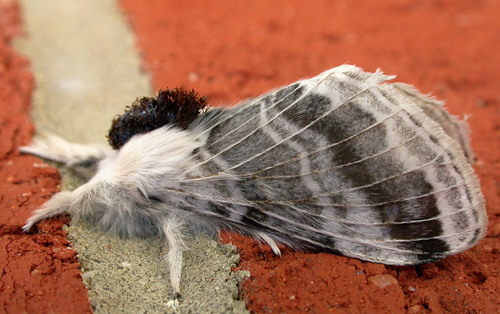


Large Tolype Moth
tolype velleda
The Large Tolype Moth (Tolype velleda) is a delightful, spectacularly fuzzy insect that looks more like a tiny flying teddy bear than a traditional moth. Belonging to the family Lasiocampidae, this charismatic creature boasts a surprisingly stout, hairy body that gives it a wonderfully plush appearance. Native to the deciduous and mixed woodlands of eastern North America, it is a fascinating example of extreme life-cycle specialization. Like many of its close relatives, the adult Large Tolype lacks functional mouthparts and lives solely to mate and reproduce during its fleeting few weeks of life in the late summer and early autumn. While the adults capture our attention with their fluffy, ghostly silhouettes drawn to porch lights, the well-camouflaged caterpillars spend their days blending perfectly into the bark of their host trees. Finding one of these gentle, fuzzy moths resting on a wall or screen door is a true treat for any nighttime nature observer.
Lebensraum: Found primarily in deciduous and mixed forests, as well as orchards and wooded suburban areas across eastern North America.
The Large Tolype Moth is unmistakable due to its exceedingly dense, woolly coat of white to pale gray hairs covering its body, thorax, and legs. Its wings feature wavy, contrasting bands of dark gray and white, creating a subtle, mottled pattern. There is a pronounced size difference between the sexes; females are notably larger, with wingspans reaching up to 8.2 cm, while the smaller males typically span 3.2 to 5.8 cm. When resting, they hold their wings somewhat flat and close to their bodies, often stretching their fuzzy front legs straight forward, making them look like a small, fluffy, white and gray pebble or a tuft of shed animal fur.
Kategorie
InsektenSeltenheit
Common
Gefahr
1/5 · Sehr gering
Snaps
Mach den ersten Snap!
Because they do not eat, adult Large Tolype Moths only live for a few weeks, focusing absolutely all their energy on finding a mate.
Females are significantly larger than males, sometimes having a wingspan almost twice the size of their male counterparts.
Their thick, plush 'fur' is actually made of specialized, modified scales that help them stay warm on chilly autumn nights.
When resting, they stretch their exceptionally fuzzy front legs straight forward, adding to their resemblance of a soft, miniature stuffed animal.
Adult moths emerge without functional mouthparts, relying entirely on the energy reserves they gathered as caterpillars to fuel their short adult lives.
Their exceptionally dense, hair-like scales provide excellent insulation during the cooler nights of late summer and autumn when they are most active.
The caterpillars are incredibly flattened and sport gray, mottled patterns with hairy fringes, allowing them to melt seamlessly into the bark of their host trees to avoid predators.
While the adult moths do not feed at all, the caterpillars are voracious herbivores that consume the leaves of various broadleaf trees and shrubs.
Altersunterschiede: Caterpillars actively forage for leaves to build up fat reserves, whereas the adult moths have vestigial mouthparts and do not eat or drink anything.
Quercus alba
Host plant for caterpillar feeding and development.
Malus domestica
Host tree that provides foliage for caterpillars.
Eptesicus fuscus
Predator that catches adult moths during their nocturnal flights.
Für dieses Objekt sind noch keine Merkmal-Badges vergeben.
Noch keine Alternativnamen vorhanden.
Sammlungen für dieses Objekt erscheinen hier, wenn weitere Themen hinzugefügt werden.
Gefahr
1/5 · Sehr gering
Noch keine besonderen Sicherheitshinweise.
Der einfachste Weg, Large Tolype Moth zu bestimmen, ist die Verwendung der Naturführer-App Snappit.
2-5 cm
3-8 cm
0.001-0.005 kg
1 Jahre
While the adult moths do not feed at all, the caterpillars are voracious herbivores that consume the leaves of various broadleaf trees and shrubs.
Found primarily in deciduous and mixed forests, as well as orchards and wooded suburban areas across eastern North America.
Foraging
Zoome hinein, um Cluster aufzulösen und zu sehen, wo dieses Objekt fotografiert wurde.
Neueste Snaps erscheinen hier, wenn neue Beobachtungen hinzukommen.




_-_(imago)%2C_Cape_Cod_(MA)%2C_United_States.jpg&width=800)






