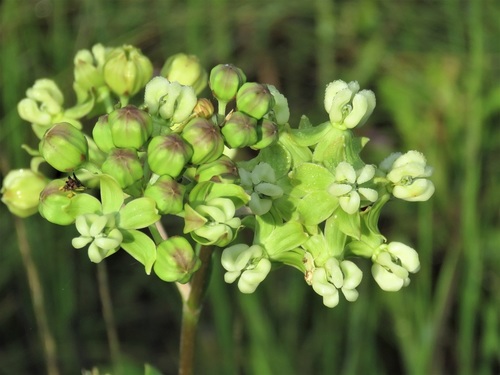


Largeflower Milkweed
asclepias connivens
Largeflower Milkweed (Asclepias connivens) is a fascinating perennial wildflower native to the damp, acidic soils of the southeastern United States. Standing out among the milkweed family, this species is named for its relatively large, uniquely structured flowers that form a crucial component of wet pine flatwood and savanna ecosystems. Unlike many of its cousins with sprawling floral clusters, it produces a more compact head of nodding, star-like blooms. As an essential member of the local flora, it plays a vital role in supporting specialized native pollinators and serves as a critical food source for various insect species. Its preference for pristine, undisturbed wetlands makes it a prized find for botanical enthusiasts exploring the southeastern coastal plains.
Lebensraum: Found in wet pine flatwoods, savannas, and acidic pitcher plant bogs across the southeastern United States.
This herbaceous plant typically grows between 40 to 100 cm tall, featuring simple, upright stems with opposite, lance-shaped leaves that clasp directly to the stem. The most distinguishing feature is the cluster of 5 to 15 large, pale green to creamy-yellow flowers, often tinged with purple. Unlike other milkweeds, the floral hoods lean inward and touch at their tips (connivent), creating a distinct closed-conical shape in the center of the bloom. When broken, the stems and leaves exude a thick, sticky white latex sap characteristic of the genus.
Kategorie
PflanzenSeltenheit
Common
Gefahr
1/5 · Sehr gering
Snaps
Mach den ersten Snap!
The Latin species name 'connivens' translates to 'converging' or 'winking', referring to the unique way the flower hoods bend inward to touch at the top.
The toxic cardenolides inside the plant's sap can cause cardiac arrest in vertebrate predators, yet specialized insects use it as a defense mechanism.
Unlike common milkweeds which have dozens of small flowers in a sphere, the Largeflower Milkweed has fewer but significantly larger individual flowers.
The floral hoods curve inward and press together at the tips, protecting the delicate pollen structures from rain while restricting access to specific strong-bodied pollinators.
When damaged, the plant exudes a sticky, white latex sap filled with toxic cardenolides, which deters generalist herbivores while serving as a chemical shield for specialist insects.
Adapted to waterlogged, nutrient-poor soils, its specialized root system can survive seasonal flooding and low-oxygen conditions common in southern wet flatwoods.
As a photoautotrophic plant, the Largeflower Milkweed manufactures its own energy using sunlight, water, and carbon dioxide through the process of photosynthesis.
Danaus plexippus
Monarch caterpillars feed exclusively on milkweed leaves, utilizing the toxic cardenolides for their own defense against predators.
Danaus gilippus
Another specialist butterfly whose larvae rely on this milkweed for both nourishment and chemical defense.
Oncopeltus fasciatus
Feeds on the seeds, flowers, and sap of the plant, absorbing its toxins to ward off predators.
Für dieses Objekt sind noch keine Merkmal-Badges vergeben.
Noch keine Alternativnamen vorhanden.
Sammlungen für dieses Objekt erscheinen hier, wenn weitere Themen hinzugefügt werden.
Gefahr
1/5 · Sehr gering
Noch keine besonderen Sicherheitshinweise.
Der einfachste Weg, Largeflower Milkweed zu bestimmen, ist die Verwendung der Naturführer-App Snappit.
40-100 cm
3-10 Jahre
As a photoautotrophic plant, the Largeflower Milkweed manufactures its own energy using sunlight, water, and carbon dioxide through the process of photosynthesis.
Found in wet pine flatwoods, savannas, and acidic pitcher plant bogs across the southeastern United States.
Zoome hinein, um Cluster aufzulösen und zu sehen, wo dieses Objekt fotografiert wurde.
Neueste Snaps erscheinen hier, wenn neue Beobachtungen hinzukommen.















