

Lax Rush
juncus oxycarpus
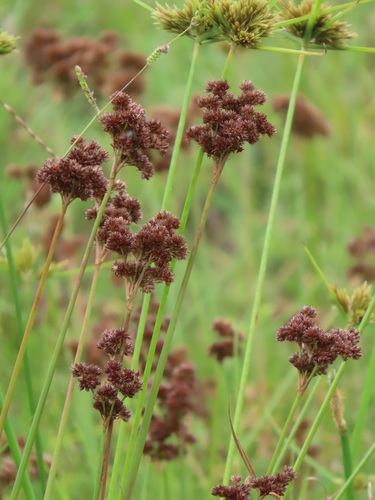
The Lax Rush (Juncus oxycarpus) is an elegant, clump-forming perennial wetland plant native to Southern and Eastern Africa. Thriving in soggy soils, stream banks, and seepages, this resilient rush plays a vital ecological role by stabilizing muddy banks and purifying water through its filtration roots. It is characterized by its slender, erect green stems and loose, branching clusters of tiny, star-shaped flowers that bloom in shades of green, bronze, and brown. Historically, rushes have been of great value to local communities, who harvested their tough, flexible stems for weaving mats and baskets. Today, it remains an essential component of wetland ecosystems, providing nesting materials for birds and cover for small aquatic organisms, while delighting nature spotters with its delicate, architectural form.
Lebensraum: Typically found in muddy wetlands, stream banks, seasonal seepages, and damp grasslands.
Lax Rush is a tufted, grass-like perennial reaching heights of 20 to 80 centimeters. Its stems are smooth, round, and bright green, arising from a creeping underground rhizome. The leaves are cylindrical, resembling the stems, and are distinctly septate—meaning they have internal chamber-like partitions that can be felt as small ridges when gently squeezed and slid between fingers. The inflorescence is a loose, spreading, terminal cluster featuring small, lance-shaped, brownish-green flowers, which mature into sharply pointed, dark brown capsules that give the species its botanical name.
Kategorie
PflanzenSeltenheit
Common
Gefahr
1/5 · Sehr gering
Snaps
Mach den ersten Snap!
If you run your fingers along a leaf of the Lax Rush, you can feel distinct interior cross-walls called septa, which act like tiny structural floors inside a hollow tube.
Rushes are often confused with grasses and sedges; botanists remember the difference with the classic rhyme: 'Sedges have edges, rushes are round, and grasses have nodes all the way to the ground.'
The species name 'oxycarpus' is derived from Greek, translating directly to 'sharp fruit,' highlighting its sharply pointed seed capsules.
The stems contain hollow, air-filled aerenchyma tissue partitioned by septa, which transports vital oxygen down to the roots in waterlogged, oxygen-depleted soils.
Its tough, creeping rhizomes form a dense underground network that stabilizes shifting mud and riverbanks against rushing water.
The tiny seeds produce a sticky, gelatinous coating when wet, helping them adhere to waterbirds for long-distance transport or anchor to muddy substrate.
As a photosynthetic plant, the Lax Rush synthesizes its own food using sunlight, water, carbon dioxide, and essential nutrients absorbed from wet soil.
Syncerus caffer
Grazes on the foliage of Lax Rush in damp marshes and riverbanks.
Typha capensis
Competes for space and sunlight in shallow wetland margins.
Rhopalosiphum nymphaeae
Feeds on the plant sap of the rush stems.
Für dieses Objekt sind noch keine Merkmal-Badges vergeben.
Noch keine Alternativnamen vorhanden.
Sammlungen für dieses Objekt erscheinen hier, wenn weitere Themen hinzugefügt werden.
Gefahr
1/5 · Sehr gering
Noch keine besonderen Sicherheitshinweise.
Der einfachste Weg, Lax Rush zu bestimmen, ist die Verwendung der Naturführer-App Snappit.
20-80 cm
3-10 Jahre
As a photosynthetic plant, the Lax Rush synthesizes its own food using sunlight, water, carbon dioxide, and essential nutrients absorbed from wet soil.
Typically found in muddy wetlands, stream banks, seasonal seepages, and damp grasslands.
Zoome hinein, um Cluster aufzulösen und zu sehen, wo dieses Objekt fotografiert wurde.
Neueste Snaps erscheinen hier, wenn neue Beobachtungen hinzukommen.