

Leavenworth'S Eryngo
eryngium leavenworthii
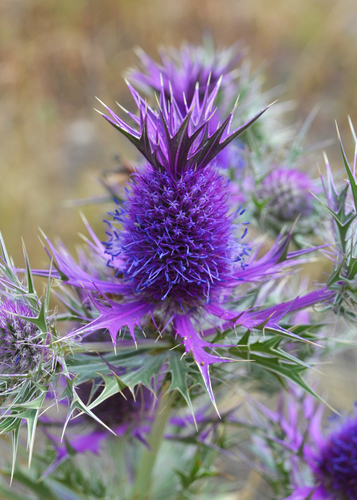
Leavenworth's Eryngo (Eryngium leavenworthii) is a striking, thistle-like annual plant native to the grasslands and prairies of the south-central United States. Known for its vibrant purple to almost neon violet coloration, this plant stands out dramatically in late summer and autumn fields. Despite its prickly appearance, it is actually a member of the Apiaceae (carrot) family, and it plays a vital role in its local ecosystem by attracting a wide variety of native pollinators. Its unique structure and robust nature make it a favorite for native plant enthusiasts and floral designers alike.
Lebensraum: Typically found in dry, open prairies, limestone glades, rocky barrens, and along sunny roadsides with calcium-rich soils.
This upright annual typically grows between 50 to 100 cm tall, featuring heavily branched, spiny stems. The most defining feature is its dense, cone-like flower heads, which are tightly packed with tiny, bright purple flowers, sitting atop a collar of sharply pointed, leaf-like bracts. The entire upper portion of the plant, including the stems and leaves, turns a brilliant, metallic shade of purple or amethyst as it matures in late summer, creating an eye-catching contrast with surrounding green or brown prairie grasses.
Kategorie
PflanzenSeltenheit
Common
Gefahr
1/5 · Sehr gering
Snaps
Mach den ersten Snap!
Despite looking almost exactly like a thistle, it is actually a member of the carrot and celery family.
Its brilliant purple color acts as an optical beacon, reflecting UV light to guide bees directly to its nectar reservoirs.
The spiky blooms retain their vivid amethyst color long after drying, making them highly prized in dry flower arrangements.
Utilizes a deep taproot and a waxy, moisture-retaining cuticle to survive the intense heat and dry conditions of late summer in the southern plains.
Possesses sharp, spine-tipped leaves and bracts that discourage grazing mammals from feeding on its foliage and flowers.
Employs highly intense purple coloration that stands out in the ultraviolet spectrum, making it exceptionally visible to pollinating insects from a distance.
As a photosynthetic plant, it generates its own energy from sunlight, water, and carbon dioxide, while absorbing essential minerals through its root system.
Danaus plexippus
Provides abundant nectar during late summer, serving as a vital food source for migrating butterflies.
Bombus pensylvanicus
Attracts native bumblebees for pollination, aiding in the plant's reproduction while providing nutrient-rich nectar.
Odocoileus virginianus
Occasionally browsed by herbivores when the plant is young and the protective spines have not yet hardened.
Für dieses Objekt sind noch keine Merkmal-Badges vergeben.
Noch keine Alternativnamen vorhanden.
Sammlungen für dieses Objekt erscheinen hier, wenn weitere Themen hinzugefügt werden.
Gefahr
1/5 · Sehr gering
Noch keine besonderen Sicherheitshinweise.
Der einfachste Weg, Leavenworth'S Eryngo zu bestimmen, ist die Verwendung der Naturführer-App Snappit.
50-100 cm
1 Jahre
As a photosynthetic plant, it generates its own energy from sunlight, water, and carbon dioxide, while absorbing essential minerals through its root system.
Typically found in dry, open prairies, limestone glades, rocky barrens, and along sunny roadsides with calcium-rich soils.
Zoome hinein, um Cluster aufzulösen und zu sehen, wo dieses Objekt fotografiert wurde.
Neueste Snaps erscheinen hier, wenn neue Beobachtungen hinzukommen.

Oklahoma, US
Hier kann man sehen Amerikanischer Bison und Präriehund.
Führer anzeigen →

Texas, US
Hier kann man sehen Fragezeichen-Falter, Knopfbusch und Granatapfel.
Führer anzeigen →
















