

Lemmon'S Paintbrush
castilleja lemmonii
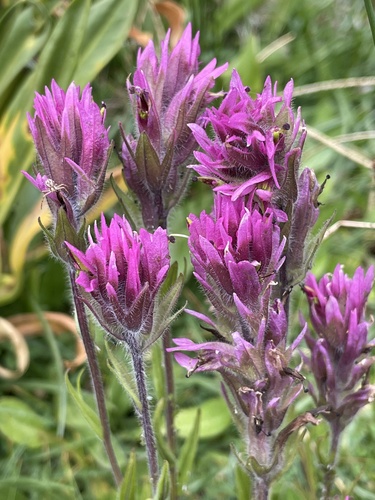
Lemmon's Paintbrush (Castilleja lemmonii) is a charming perennial wildflower native to the high-elevation meadows and subalpine zones of the Sierra Nevada and southern Cascade Range. Standing relatively low compared to some of its flashy relatives, this alpine beauty is celebrated for its dense, purplish to rose-pink inflorescences that add vibrant splashes of color to moist mountain landscapes during the short summer season. Like other members of the broomrape family (Orobanchaceae), Lemmon's Paintbrush is a hemiparasite. While it is fully capable of photosynthesis, it cleverly taps into the root systems of neighboring grasses, sedges, and shrubs to steal water and key nutrients, helping it thrive in nutrient-poor alpine soils.
Lebensraum: Found in high-elevation moist meadows, subalpine forests, and wet rocky seeps of the Sierra Nevada and Cascade ranges.
This herbaceous plant typically reaches heights of 10 to 30 centimeters, featuring erect, unbranched stems that are coated in fine hairs. The leaves are narrow, lance-shaped, and mostly entire (unlobed). The defining feature is its brush-like flower cluster, where the true, inconspicuous greenish flowers are hidden within showy, purplish-red to deep pinkish-purple bracts. These colorful bracts are usually 1.5 to 2.5 centimeters long, occasionally tipped with yellow-green, creating a compact and fuzzy-looking terminal spike.
Kategorie
PflanzenSeltenheit
Common
Gefahr
1/5 · Sehr gering
Snaps
Mach den ersten Snap!
Because they are hemiparasitic, attempting to transplant Lemmon's Paintbrush into a garden usually fails because they cannot survive long without their host plants.
Despite their bright appearance, the 'petals' you see are actually modified leaves called bracts; the actual flowers are small, narrow green tubes hidden inside.
This species was named after John Gill Lemmon, a prominent 19th-century Civil War veteran and botanist who explored the Western United States.
Uses specialized root structures called haustoria to penetrate and attach to the roots of neighboring plants, extracting water and essential minerals.
Accumulates soluble sugars and specialized proteins in its tissues to withstand sudden freezing temperatures common in high-altitude environments.
Employs highly UV-reflective, bright purple-pink bracts to guide high-altitude pollinators directly to its hidden nectar tubes.
As a photosynthetic plant, it produces its own energy via sunlight, but supplements its water and mineral intake by parasitizing host plants.
Altersunterschiede: Seedlings rely entirely on internal seed reserves until they establish green leaves for photosynthesis and connect to a host plant's root system.
Carex helleri
Acts as a primary host plant, providing water and nutrients to Castilleja lemmonii through root connections.
Selasphorus rufus
Visits the bright purple bracts to feed on nectar, serving as a key pollinator.
Bombus huntii
Feeds on the nectar and helps cross-pollinate the flowers in subalpine meadows.
Für dieses Objekt sind noch keine Merkmal-Badges vergeben.
Noch keine Alternativnamen vorhanden.
Sammlungen für dieses Objekt erscheinen hier, wenn weitere Themen hinzugefügt werden.
Gefahr
1/5 · Sehr gering
Noch keine besonderen Sicherheitshinweise.
Der einfachste Weg, Lemmon'S Paintbrush zu bestimmen, ist die Verwendung der Naturführer-App Snappit.
10-30 cm
0.01-0.05 kg
3-8 Jahre
As a photosynthetic plant, it produces its own energy via sunlight, but supplements its water and mineral intake by parasitizing host plants.
Found in high-elevation moist meadows, subalpine forests, and wet rocky seeps of the Sierra Nevada and Cascade ranges.
Foraging
Zoome hinein, um Cluster aufzulösen und zu sehen, wo dieses Objekt fotografiert wurde.
Neueste Snaps erscheinen hier, wenn neue Beobachtungen hinzukommen.
















