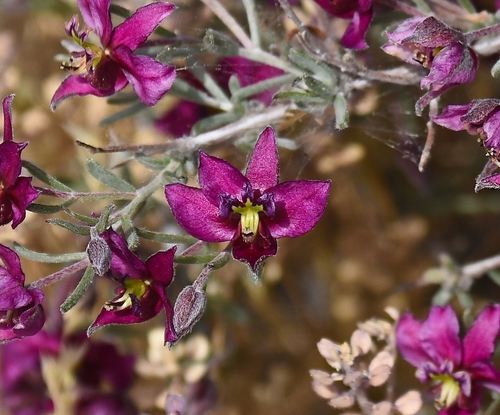


Littleleaf Rhatany
krameria erecta
Littleleaf Rhatany (Krameria erecta) is a highly resilient, low-growing woody shrub native to the arid desert regions of the southwestern United States and northern Mexico. Despite thriving in extremely harsh environments, this plant employs a fascinating survival mechanism: it is a root hemiparasite. While it contains chlorophyll and can photosynthesize, it actively siphons water and vital minerals from the roots of neighboring plants like the creosote bush to bolster its survival. This allows it to remain vibrant and bloom even during periods of intense desert drought.
Lebensraum: Found in dry, rocky or sandy desert flats, gravelly slopes, and desert scrub communities, typically growing in close proximity to host plants.
This species is a compact, densely branched shrub reaching 15 to 80 centimeters in height, characterized by an intricate tangle of gray-green, zig-zagging stems covered in soft, silvery hairs. Its leaves are exceptionally tiny, narrow, and linear. During spring and late summer, it produces small but striking magenta to deep purple flowers featuring five petal-like sepals and distinct, gland-like petals that secrete oil. Its seed pods are small, rounded, and adorned with numerous purplish, barbed prickles.
Kategorie
PflanzenSeltenheit
Common
Gefahr
1/5 · Sehr gering
Snaps
Mach den ersten Snap!
Instead of sweet nectar, Littleleaf Rhatany produces specialized lipid oils to attract its primary pollinators.
The roots are rich in tannins and were historically used by Native Americans as a crimson-red dye and as an astringent medicine.
The seed pods are covered in tiny, hook-like barbs that stick to passing animals to help disperse the seeds.
Utilizes specialized structures called haustoria to attach to and draw water and nutrients from the root systems of neighboring desert plants.
Features specialized glands (elaiophores) that produce rich oils instead of nectar to attract highly specialized Centris bee pollinators.
Its stems and tiny leaves are coated in fine, silvery hairs that reflect intense desert sunlight, reducing moisture loss.
As a hemiparasite, it generates energy through photosynthesis while obtaining supplementary water and inorganic nutrients from the roots of host plants.
Altersunterschiede: Seedlings rely on cotyledon reserves before attaching to a host root system to establish nutritional independence.
Larrea tridentata
Siphons essential water and minerals from this desert shrub's root system.
Centris pallida
Pollinated by this specialized bee, which collects the plant's unique floral oils to feed its larvae.
Neotoma albigula
Occasionally browsed for foliage and used as protective nesting material.
Für dieses Objekt sind noch keine Merkmal-Badges vergeben.
Noch keine Alternativnamen vorhanden.
Sammlungen für dieses Objekt erscheinen hier, wenn weitere Themen hinzugefügt werden.
Gefahr
1/5 · Sehr gering
Noch keine besonderen Sicherheitshinweise.
Der einfachste Weg, Littleleaf Rhatany zu bestimmen, ist die Verwendung der Naturführer-App Snappit.
15-80 cm
10-50 Jahre
As a hemiparasite, it generates energy through photosynthesis while obtaining supplementary water and inorganic nutrients from the roots of host plants.
Found in dry, rocky or sandy desert flats, gravelly slopes, and desert scrub communities, typically growing in close proximity to host plants.
Parasitic Absorption
Zoome hinein, um Cluster aufzulösen und zu sehen, wo dieses Objekt fotografiert wurde.
Neueste Snaps erscheinen hier, wenn neue Beobachtungen hinzukommen.




.JPG&width=800)