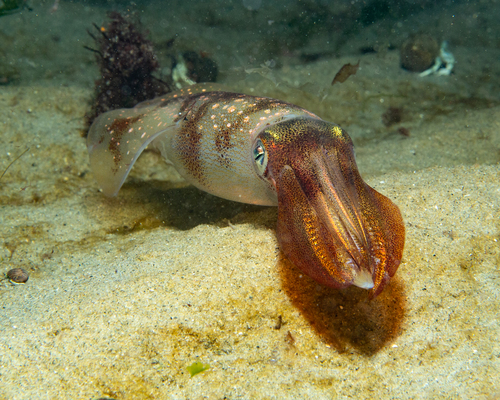


Longfin Inshore Squid
doryteuthis pealeii
The Longfin Inshore Squid (Doryteuthis pealeii) is a highly dynamic cephalopod found in the northwest Atlantic Ocean. Well-known for its schooling behavior and incredibly rapid movements, this species plays a vital ecological role both as a voracious predator of small fish and crustaceans, and as a primary food source for marine mammals, seabirds, and larger fish. They are remarkable for their complex social interactions, which are largely mediated by their highly advanced, instantaneous color-changing capabilities. In scientific history, this squid holds a legendary status. Its giant axon, which is hundreds of times larger than a human neuron, served as the foundational model organism for pioneering neurobiologists, leading directly to the discovery of how nerve impulses travel along cellular pathways.
Lebensraum: Typically found in temperate continental shelf and slope waters, ranging from very shallow coastal bays and estuaries during summer to deep offshore waters up to 400 meters in winter.
This squid features a long, torpedo-shaped mantle with large, rhomboidal fins that extend along at least half of the total length of its body. Its coloration is highly variable due to specialized pigment cells, rapidly shifting from translucent white and iridescent greens to deep reddish-browns depending on its environment and emotional state. It possesses eight arms and two longer feeding tentacles lined with sharp-ringed suckers, alongside large, complex eyes that lack a cornea.
Kategorie
InvertebrateSeltenheit
Common
Gefahr
1/5 · Sehr gering
Snaps
Mach den ersten Snap!
Like most squids, they possess three separate hearts: two branchial hearts to pump blood to the gills and one central systemic heart to circulate blood to the rest of the body.
The giant axon of this squid is up to 1,000 times wider than a human neuron, which made it highly instrumental in the discovery of how nerve cells transmit electrical signals.
They lay their eggs in communal spawning grounds, creating large, clustered structures of gelatinous capsules often called 'sea mops'.
Using specialized pigment cells controlled directly by its brain, the squid can instantaneously alter its skin color and patterns to camouflage or communicate with other squids.
By forcefully expelling water from its muscular mantle through a directional siphon, it can achieve incredibly fast bursts of forward or backward acceleration.
Possesses a giant axon system that transmits electrical impulses at extreme speeds, allowing for near-instantaneous escape reflexes when threatened.
An active and opportunistic predator that hunts in schools, preying primarily on small schooling fish, crustaceans, and other cephalopods.
Altersunterschiede: Larvae and juveniles feed on tiny planktonic copepods and larval fish, while adults transition to larger fish, crabs, and frequently engage in cannibalism of smaller squid.
Pomatomus saltatrix
The bluefish is a major predator of the longfin inshore squid in coastal waters during the summer months.
Clupea harengus
Adult squids actively hunt schools of young Atlantic herring as a primary energy source.
Paralichthys dentatus
Summer flounders share sandy bottom habitats and prey heavily upon squid resting near the sea floor.
Für dieses Objekt sind noch keine Merkmal-Badges vergeben.
Noch keine Alternativnamen vorhanden.
Sammlungen für dieses Objekt erscheinen hier, wenn weitere Themen hinzugefügt werden.
Gefahr
1/5 · Sehr gering
Noch keine besonderen Sicherheitshinweise.
Der einfachste Weg, Longfin Inshore Squid zu bestimmen, ist die Verwendung der Naturführer-App Snappit.
1550+ cm
0.10101+ kg
11+ Jahre
25 km/h
An active and opportunistic predator that hunts in schools, preying primarily on small schooling fish, crustaceans, and other cephalopods.
Typically found in temperate continental shelf and slope waters, ranging from very shallow coastal bays and estuaries during summer to deep offshore waters up to 400 meters in winter.
Pursuit
Zoome hinein, um Cluster aufzulösen und zu sehen, wo dieses Objekt fotografiert wurde.
Neueste Snaps erscheinen hier, wenn neue Beobachtungen hinzukommen.








