

Longleaf Buckwheat
eriogonum longifolium
The Longleaf Buckwheat is a resilient perennial wildflower native to the sandy, open habitats of the central and southern United States. This plant is characterized by a low-lying basal rosette of long, slender, silver-green leaves and a towering, skeletal flowering stem that can rise over a meter tall during the summer months. As a member of the wild buckwheat family, it plays a vital ecological role by providing nectar to a diverse array of native bees, butterflies, and other pollinators, while its deep taproot helps bind loose, sandy soils. While the species is relatively secure across its broader range, certain regional varieties, such as the scrub buckwheat in Florida, are highly threatened by habitat loss, making encounters with this tough but delicate wildflower a special treat for nature enthusiasts.
Lebensraum: Found in open, dry sandy areas, post oak woodlands, limestone glades, and pine-oak scrublands.
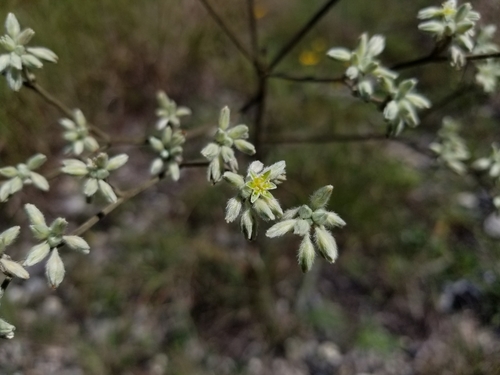
This species features a basal rosette of long, lance-shaped leaves that are rich green on top and coated in dense, woolly white hairs underneath. In late summer, it produces a tall, highly branched, nearly leafless stalk adorned with small, terminal clusters of petal-less, bell-shaped flowers. These flowers are typically creamy white, pale yellow, or light pink, turning a warm, rusty bronze color as they dry and go to seed.
Kategorie
PflanzenSeltenheit
Common
Gefahr
1/5 · Sehr gering
Snaps
Mach den ersten Snap!
Its genus name, Eriogonum, translates from Greek to 'woolly knees,' referring to the hairy jointed nodes of many species in this group.
The plant relies heavily on periodic wildfires to clear out competing overstory canopy and stimulate the germination of its seeds.
The species includes the federally threatened Scrub Buckwheat, which is endemic to Florida's disappearing sandhill habitats.
Features a long, sturdy taproot that digs deep into nutrient-poor sandy soils to access water and anchor the plant.
The undersides of the leaves are coated in a dense layer of white hairs that trap moisture and reflect intense solar radiation.
Adapted to survive low-intensity wildfires, regrowing quickly from its subterranean woody caudex after a burn.
As a photoautotrophic plant, it produces its own energy via photosynthesis using sunlight, water, and soil nutrients.
Strymon melinus
The flowers provide high-quality nectar, and the plant serves as a larval host for this butterfly species.
Lasioglossum pectorale
Native sweat bees feed on the abundant nectar and act as key pollinators for the plant.
Odocoileus virginianus
White-tailed deer occasionally browse on the leaves and flowering stems despite their tough texture.
Für dieses Objekt sind noch keine Merkmal-Badges vergeben.
Noch keine Alternativnamen vorhanden.
Sammlungen für dieses Objekt erscheinen hier, wenn weitere Themen hinzugefügt werden.
Gefahr
1/5 · Sehr gering
Noch keine besonderen Sicherheitshinweise.
Der einfachste Weg, Longleaf Buckwheat zu bestimmen, ist die Verwendung der Naturführer-App Snappit.
30-150 cm
3-10 Jahre
As a photoautotrophic plant, it produces its own energy via photosynthesis using sunlight, water, and soil nutrients.
Found in open, dry sandy areas, post oak woodlands, limestone glades, and pine-oak scrublands.
Photosynthesis
Zoome hinein, um Cluster aufzulösen und zu sehen, wo dieses Objekt fotografiert wurde.
Neueste Snaps erscheinen hier, wenn neue Beobachtungen hinzukommen.