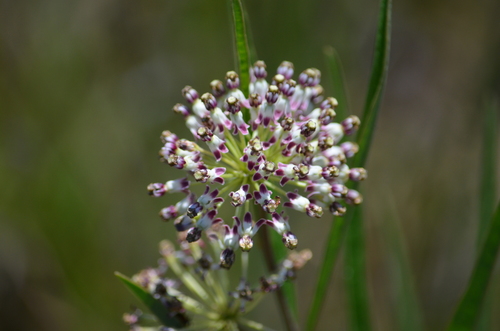


Longleaf Milkweed
asclepias longifolia
The Longleaf Milkweed is a slender, perennial wildflower native to the coastal plains of the southeastern United States. Thriving in wet pine flatwoods, pitcher plant bogs, and grassy savannas, this species plays a vital role in its fire-adapted ecosystem. Unlike its broader-leaved cousins, it features grass-like leaves that help it blend seamlessly into the surrounding herbaceous understory until its striking flowers bloom. Like all milkweeds, it is an essential component of local food webs, providing critical nectar to native bees and acting as a specialized host plant for certain insect larvae. Its toxic sap containing cardenolides serves as an evolutionary defense mechanism, which is famously sequestered by some insects for their own protection. It is a resilient and fascinating representative of the rich, moist pine grasslands of the American South.
Lebensraum: Found in moist, acidic, sandy soils of wet pine flatwoods, savannas, and low bogs of the southeastern United States.
This herbaceous perennial grows upright to a height of 30 to 80 cm. It is easily identified by its extremely narrow, linear, grass-like leaves that are oppositely arranged along the stem and measure up to 15 cm in length. The flowers are arranged in terminal or axillary umbels, displaying a delicate blend of pale green, white, and purplish-pink hues. Its distinctive crown of hoods and horns is typical of the Asclepias genus but more compact. After pollination, it produces long, slender, upright seed pods (follicles) that eventually split open to release flat, brown seeds, each adorned with a tuft of white, silky hairs that aid in wind dispersal.
Kategorie
PflanzenSeltenheit
Common
Gefahr
1/5 · Sehr gering
Snaps
Mach den ersten Snap!
Its leaves are so narrow and grass-like that the plant is often completely overlooked when it is not in bloom.
The scientific genus name Asclepias honors Asklepios, the ancient Greek god of healing and medicine, because of the plants' historical therapeutic uses.
The silky fibers attached to its seeds are incredibly buoyant and were historically harvested during World War II as a substitute for kapok in military life preservers.
Produces a sticky, white sap filled with toxic cardenolides (cardiac glycosides) that deters most herbivores and pests.
Seeds are equipped with a plume of fine, silky hairs called a coma, allowing them to drift long distances on wind currents.
Pollen is packaged in specialized, sticky sacs called pollinia that cling to the legs of visiting insects for highly efficient cross-pollination.
As a photoautotroph, this species synthesizes its own organic compounds from sunlight, water, and carbon dioxide through photosynthesis while absorbing essential minerals from wet, acidic soils.
Danaus plexippus
Serves as a critical larval host plant, with caterpillars feeding on the foliage to sequester defensive toxins.
Bombus impatiens
Visits the blossoms to collect nectar, inadvertently carrying away pollinia on its legs to facilitate pollination.
Für dieses Objekt sind noch keine Merkmal-Badges vergeben.
Noch keine Alternativnamen vorhanden.
Sammlungen für dieses Objekt erscheinen hier, wenn weitere Themen hinzugefügt werden.
Gefahr
1/5 · Sehr gering
Noch keine besonderen Sicherheitshinweise.
Der einfachste Weg, Longleaf Milkweed zu bestimmen, ist die Verwendung der Naturführer-App Snappit.
30-80 cm
0.03-0.15 kg
5-15 Jahre
As a photoautotroph, this species synthesizes its own organic compounds from sunlight, water, and carbon dioxide through photosynthesis while absorbing essential minerals from wet, acidic soils.
Found in moist, acidic, sandy soils of wet pine flatwoods, savannas, and low bogs of the southeastern United States.
14-30 Tage
Zoome hinein, um Cluster aufzulösen und zu sehen, wo dieses Objekt fotografiert wurde.
Neueste Snaps erscheinen hier, wenn neue Beobachtungen hinzukommen.









%2C_jard%C3%ADn_bot%C3%A1nico_alpino-%C3%A1rtico%2C_Troms%C3%B8%2C_Noruega%2C_2019-09-04%2C_DD_81.jpg&width=800)












