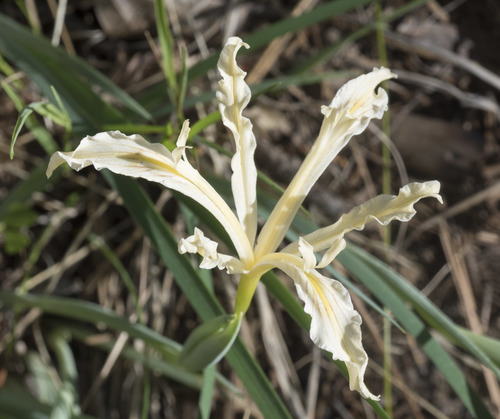


Longtube Iris
iris tenuissima
The Longtube Iris (Iris tenuissima) is an elegant wild iris endemic to the dry, open woodlands of northern California and southern Oregon. This delicate perennial wildflower emerges in late spring, gracing the forest floor with its uniquely slender and intricate blossoms. Rising from thin, creeping rhizomes, it thrives in the dappled shade of coniferous forests where it serves as a vital early-season nectar source for native pollinators. Unlike some of its moisture-loving relatives, the Longtube Iris is beautifully adapted to dry slopes and rocky soils, making it a rugged survivor of the chaparral and montane understories. Its quiet, understated beauty makes it a highly sought-after sight for native plant enthusiasts hiking through the Pacific Northwest's diverse woodlands.
Lebensraum: Found in dry, open coniferous woodlands, pine-oak forests, and brushy slopes of northern California and southwestern Oregon.
This slender plant stands 15 to 35 centimeters tall, featuring narrow, grass-like leaves that are pale green and up to 6 millimeters wide. Its most distinguishing feature is the flower, which is typically creamy white to pale yellow, marked with delicate, prominent veins of purple, lavender, or reddish-brown. The flower is characterized by an exceptionally long and narrow perianth tube, ranging from 3 to 5 centimeters, supporting up to two flowers per stem with slender, spreading sepals and upright petals that curl gently outward.
Kategorie
PflanzenSeltenheit
Common
Gefahr
1/5 · Sehr gering
Snaps
Mach den ersten Snap!
Its unusually long floral tube acts like an evolutionary lock-and-key mechanism, limiting nectar access mostly to bees and butterflies with long proboscises.
The species name 'tenuissima' translates to 'very slender' or 'most thin,' referring to the delicate, narrow profile of its leaves and stem.
Unlike many garden irises which require boggy or moist soil, the Longtube Iris prefers extremely dry, rocky, and acidic soils under pine trees.
Possesses an exceptionally long floral tube that restricts nectar access to specific long-tongued pollinators, ensuring highly efficient pollen transfer.
Utilizes an underground rhizome system to store energy, allowing the plant to rapidly regenerate and bloom after seasonal forest fires.
Features tough, fibrous, grass-like leaves and a specialized root system designed to conserve water and survive hot, dry Mediterranean summers.
As a photoautotrophic plant, the Longtube Iris synthesizes its own food using sunlight, carbon dioxide, water, and essential soil minerals through photosynthesis.
Bombus vosnesenskii
Pollinated by this native bumblebee species, which is attracted to its nectar and fits the floral anatomy.
Pinus ponderosa
Grows under the canopy of this dominant conifer, benefiting from its filtered shade and acidic needle mulch.
Für dieses Objekt sind noch keine Merkmal-Badges vergeben.
Noch keine Alternativnamen vorhanden.
Sammlungen für dieses Objekt erscheinen hier, wenn weitere Themen hinzugefügt werden.
Gefahr
1/5 · Sehr gering
Noch keine besonderen Sicherheitshinweise.
Der einfachste Weg, Longtube Iris zu bestimmen, ist die Verwendung der Naturführer-App Snappit.
15-35 cm
0.02-0.08 kg
5-15 Jahre
As a photoautotrophic plant, the Longtube Iris synthesizes its own food using sunlight, carbon dioxide, water, and essential soil minerals through photosynthesis.
Found in dry, open coniferous woodlands, pine-oak forests, and brushy slopes of northern California and southwestern Oregon.
Zoome hinein, um Cluster aufzulösen und zu sehen, wo dieses Objekt fotografiert wurde.
Neueste Snaps erscheinen hier, wenn neue Beobachtungen hinzukommen.