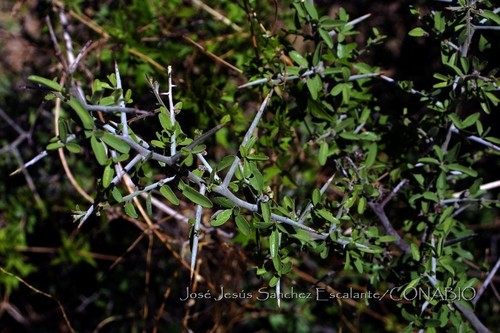


Lotebush
condaliopsis obtusifolia
The Lotebush (Condaliopsis obtusifolia) is a resilient, heavily armed shrub native to the arid and semi-arid regions of the southwestern United States and northern Mexico. Often referred to as gum-elastic or bluebrush, this stiff, intricately branched plant plays a vital role in its ecosystem by forming dense, protective thickets. These thickets provide critical nesting sites, shade, and escape cover for desert wildlife, including birds, rodents, and small mammals who brave its thorns for safety.
Lebensraum: Typically found in dry desert scrublands, open grasslands, chaparral, and rocky canyon slopes of the American Southwest and northern Mexico.
Lotebush is a multi-branched, gray-green shrub that typically grows between 1 and 3 meters in height. It features rigid, zig-zagging branches that terminate in extremely sharp, stout thorns. The leaves are small, oblong to oval, and pale gray-green, which the plant often sheds during dry periods. In late spring and summer, it produces inconspicuous, tiny greenish-yellow flowers that mature into small, fleshy, globose drupes that turn a dark blue to near-black color when ripe.
Kategorie
PflanzenSeltenheit
Common
Gefahr
1/5 · Sehr gering
Snaps
Mach den ersten Snap!
Indigenous peoples of the Southwest historically boiled the roots of the lotebush to create a soothing lather used to treat wounds and wash sores.
The plant acts as a 'nurse plant' in desert ecosystems, sheltering tender young seedlings of other plant species from harsh sun and hungry herbivores.
While the bitter, dark blue fruits are unpleasant to human tastes, they are highly nutritious and eagerly sought after by local desert birds and coyotes.
To conserve water during extreme dry spells, the lotebush can drop all its leaves and perform photosynthesis directly through its green, chlorophyll-rich bark.
The branch tips taper into stiff, needle-sharp thorns that deter large mammalian herbivores from browsing its foliage and protect nesting birds inside.
It possesses an extensive and deep root system designed to tap into underground moisture reserves deep beneath arid soils.
As a photosynthetic plant, the lotebush produces its own organic compounds using sunlight, carbon dioxide, and water drawn from the desert soil.

Phainopepla nitens
The berries of the lotebush are a prized food source for this desert bird, which in turn helps disperse the shrub's seeds.
Mimus polyglottos
Provides critical, predator-proof nesting sites within its extremely dense and thorny branches.
Odocoileus virginianus
Carefully browses the tender new growth of leaves and twigs despite the intimidating thorns.
Für dieses Objekt sind noch keine Merkmal-Badges vergeben.
Noch keine Alternativnamen vorhanden.
Sammlungen für dieses Objekt erscheinen hier, wenn weitere Themen hinzugefügt werden.
Gefahr
1/5 · Sehr gering
Noch keine besonderen Sicherheitshinweise.
Der einfachste Weg, Lotebush zu bestimmen, ist die Verwendung der Naturführer-App Snappit.
100-300 cm
30-100 Jahre
As a photosynthetic plant, the lotebush produces its own organic compounds using sunlight, carbon dioxide, and water drawn from the desert soil.
Typically found in dry desert scrublands, open grasslands, chaparral, and rocky canyon slopes of the American Southwest and northern Mexico.
Zoome hinein, um Cluster aufzulösen und zu sehen, wo dieses Objekt fotografiert wurde.
Neueste Snaps erscheinen hier, wenn neue Beobachtungen hinzukommen.















