

Lythrum Family
lythraceae
The Lythrum family, scientifically known as Lythraceae, is a diverse botanical group containing over 600 species of flowering plants, ranging from small aquatic herbs to towering tropical trees. This remarkable family is celebrated worldwide for both its economic and ecological importance. It includes beloved fruit-bearing plants like the pomegranate, culturally significant species like the henna tree, and striking ornamental trees like the crape myrtle. While many species are native to tropical and subtropical regions, several hardy members thrive in temperate zones, often dominating wetland ecosystems. The family is incredibly adaptable, with some species evolving into notorious aquatic invasives, such as purple loosestrife and the water chestnut. Whether providing vibrant garden blooms, ancient dyes, or juicy fruits, the Lythraceae family boasts a rich botanical history deeply intertwined with human agriculture, horticulture, and global wetland ecology.
Lebensraum: Found predominantly in tropical and subtropical regions, many species are highly adapted to wetlands, marshes, and riverbanks, while others thrive in dry woodlands or are heavily cultivated in urban gardens.
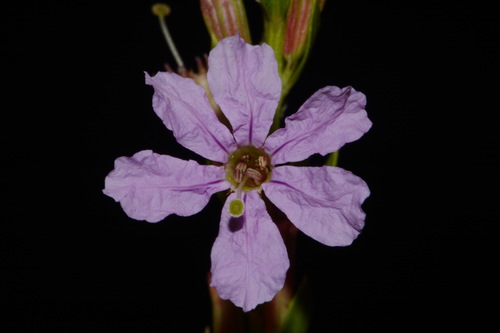
Members of the Lythraceae family are diverse in form but share several distinct visual characteristics. Their leaves are typically simple, with smooth margins, and arranged in opposite pairs or whorls along the stem. The most defining feature is their striking flowers, which often emerge from a prominent, tubular or bell-shaped structure called a hypanthium. The petals attached to the rim of this tube frequently have a distinctive, crumpled texture resembling delicate crepe paper. Flower colors range vibrantly from deep purples, fiery reds, and bright pinks to stark whites. Their fruits are incredibly varied, ranging from the thick-skinned, seed-filled leathery berry of the pomegranate to dry woody capsules and unusually shaped, spiky floating nuts.
Kategorie
PflanzenSeltenheit
Common
Gefahr
1/5 · Sehr gering
Snaps
Mach den ersten Snap!
Purple loosestrife, a beautiful but notoriously invasive wetland plant, can produce over two million tiny seeds per year, allowing it to quickly choke out native North American vegetation.
The ancient art of mehndi uses a dye derived from the crushed leaves of the henna tree (Lawsonia inermis), a famous member of the Lythraceae family.
The family includes the pomegranate, an ancient fruit celebrated in mythology, whose botanical name 'Punica' refers to the Phoenicians who helped spread its cultivation.
Water chestnuts (Trapa natans), known for their bizarre, bat-shaped floating nuts, belong to this family and have been harvested for food in Asia for over 3,000 years.
The flowers possess uniquely crumpled petals that emerge from a specialized tubular hypanthium, creating a visually striking and structurally supportive target for specific pollinators.
Many herbaceous wetland species develop spongy, air-filled tissues in their stems and roots, allowing them to remain buoyant and exchange gases efficiently in flooded, oxygen-poor environments.
Several species exhibit distinct floral morphs with varying pistil and stamen lengths, an intricate evolutionary strategy to prevent self-pollination and maximize genetic diversity.
As photosynthetic plants, members of the Lythraceae family produce their own energy by converting sunlight, water, and atmospheric carbon dioxide into essential carbohydrates.
Altersunterschiede: Seedlings rely on energy stored in the seed's endosperm until they develop true leaves capable of sustaining efficient photosynthesis.
Apis mellifera
A major pollinator of flowering Lythraceae species, particularly attracted to the abundant nectar of purple loosestrife.
Galerucella calmariensis
A specialist herbivore utilized globally as a biological control agent to manage highly invasive purple loosestrife populations.
Psittacula krameri
Consumes the nutrient-dense arils and seeds of various Lythraceae species, including the commercially cultivated pomegranate.
Für dieses Objekt sind noch keine Merkmal-Badges vergeben.
Sammlungen für dieses Objekt erscheinen hier, wenn weitere Themen hinzugefügt werden.
Gefahr
1/5 · Sehr gering
Noch keine besonderen Sicherheitshinweise.
Der einfachste Weg, Lythrum Family zu bestimmen, ist die Verwendung der Naturführer-App Snappit.
5-3000 cm
0.01-5000 kg
1-200 Jahre
As photosynthetic plants, members of the Lythraceae family produce their own energy by converting sunlight, water, and atmospheric carbon dioxide into essential carbohydrates.
Found predominantly in tropical and subtropical regions, many species are highly adapted to wetlands, marshes, and riverbanks, while others thrive in dry woodlands or are heavily cultivated in urban gardens.
Photosynthesis
1-2000
Zoome hinein, um Cluster aufzulösen und zu sehen, wo dieses Objekt fotografiert wurde.
Neueste Snaps erscheinen hier, wenn neue Beobachtungen hinzukommen.









.jpg&width=800)






