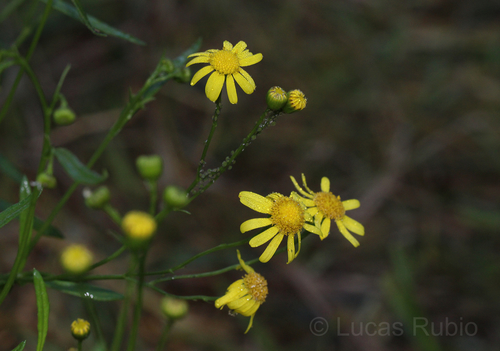


Madagascar Ragwort
senecio madagascariensis
Madagascar Ragwort (Senecio madagascariensis) is a vibrant, daisy-like flowering plant native to Madagascar, which has gained notoriety as a highly invasive weed in many parts of the world, including Australia, South Africa, and parts of the Americas. This adaptable species is characterized by its bright yellow flowers and rapid growth, allowing it to quickly colonize disturbed areas. Despite its appealing appearance, it poses significant threats to agriculture and natural ecosystems due to its toxicity to livestock and its ability to outcompete native flora. Its aggressive spread makes it a prime example of the ecological challenges posed by introduced species.
Lebensraum: Madagascar Ragwort is typically found in disturbed sites such as pastures, cultivated fields, roadsides, urban vacant lots, grasslands, and riparian zones.
This herbaceous plant typically grows upright, reaching heights of 20-60 cm, though it can sometimes sprawl. It features bright yellow, daisy-like flower heads, each about 1.5-2.5 cm in diameter, borne in loose clusters at the tips of the branches. Each flower head has numerous ray florets (petals) surrounding a dense center of disc florets. The leaves are typically dark green, alternate, lobed or deeply toothed, and vary in shape from lanceolate to obovate, often with a somewhat fleshy texture. Stems are usually green, often with reddish or purplish tints, and can be hairy or smooth.
Kategorie
PflanzenSeltenheit
Common
Gefahr
1/5 · Sehr gering
Snaps
Mach den ersten Snap!
Despite its common name, it is a significant invasive plant outside of Madagascar, causing substantial agricultural and ecological damage.
Each plant can produce tens of thousands of tiny, wind-dispersed seeds, contributing to its rapid and widespread invasion.
Its bright yellow flowers, while attractive, are often a warning sign to farmers and land managers of its presence.
The plant contains toxic pyrrolizidine alkaloids, which can cause severe liver damage and even death in grazing livestock if ingested over time.
This plant produces a high number of seeds that are easily dispersed by wind, allowing it to rapidly colonize new, disturbed areas and quickly establish dense populations.
It contains pyrrolizidine alkaloids, which are toxic to livestock, particularly horses and cattle, causing liver damage and making it a significant threat in grazing lands.
Madagascar Ragwort is highly adaptable to a wide range of soil types and environmental conditions, enabling it to thrive in diverse habitats from coastal areas to high altitudes.
Madagascar Ragwort produces its own food through photosynthesis, utilizing sunlight, carbon dioxide from the air, and water and mineral nutrients absorbed from the soil.
Bos taurus
Ingests toxic plant material, leading to illness.
Botanophila seneciella
Larvae feed on seeds within the flower heads, used as a biological control agent.
Lolium perenne
Competes with this plant for light, water, and nutrients in pastures and disturbed areas.
Puccinia expansa
A rust fungus that infects the plant, causing disease, and is used for biocontrol.
Für dieses Objekt sind noch keine Merkmal-Badges vergeben.
Noch keine Alternativnamen vorhanden.
Sammlungen für dieses Objekt erscheinen hier, wenn weitere Themen hinzugefügt werden.
Gefahr
1/5 · Sehr gering
Noch keine besonderen Sicherheitshinweise.
Der einfachste Weg, Madagascar Ragwort zu bestimmen, ist die Verwendung der Naturführer-App Snappit.
20-60 cm
1-3 Jahre
Madagascar Ragwort produces its own food through photosynthesis, utilizing sunlight, carbon dioxide from the air, and water and mineral nutrients absorbed from the soil.
Madagascar Ragwort is typically found in disturbed sites such as pastures, cultivated fields, roadsides, urban vacant lots, grasslands, and riparian zones.
Foraging (for Water And Nutrients), Photosynthesis
5000-100000
Zoome hinein, um Cluster aufzulösen und zu sehen, wo dieses Objekt fotografiert wurde.
Neueste Snaps erscheinen hier, wenn neue Beobachtungen hinzukommen.




.jpg&width=800)




.jpg&width=800)