

Malayan Tapir
tapirus indicus
The Malayan Tapir (Tapirus indicus) is an extraordinary and ancient mammal, often referred to as a 'living fossil' due to its evolutionary lineage that has remained largely unchanged for millions of years. As the only tapir species native to Asia, this gentle giant plays a crucial ecological role as a seed disperser, helping to shape and regenerate the tropical rainforests it calls home. Despite their large, robust bodies, Malayan tapirs are notoriously shy, solitary creatures that glide silently through the dense undergrowth, emerging mostly under the cover of darkness. What makes the Malayan tapir truly captivating is its unique blend of unusual physical traits—featuring a flexible snout reminiscent of an elephant's trunk and a body structure resembling a pig, yet being phylogenetically related to horses and rhinos. Spotting one of these elusive forest-dwellers is an unforgettable experience, offering a glimpse into a primordial world.
Lebensraum: Typically found in primary and secondary tropical rainforests, lower montane forests, and swampy forest ecosystems of Southeast Asia.
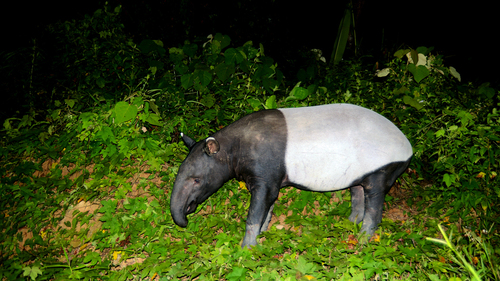
The Malayan tapir is easily recognized by its distinctive bipartite coloration, featuring a stark white 'saddle' patch that covers its back, flanks, and belly, while its head, shoulders, and legs are a deep velvety black. This unique contrast serves as highly effective disruptive camouflage in the dim, dappled light of the rainforest floor. Adults possess a heavy, rounded torso, a short tail, and a highly flexible, prehensile snout. Their ears are edged in white, and they stand on stocky legs, with four toes on each front foot and three on each hind foot.
Kategorie
SäugetiereSeltenheit
Common
Gefahr
1/5 · Sehr gering
Snaps
Mach den ersten Snap!
Baby tapirs look entirely different from their parents; they are born with reddish-brown coats decorated with beautiful white stripes and spots to mimic dappled sunlight, which fade after five months.
Despite their pig-like bodies and elephant-like snouts, Malayan tapirs are odd-toed ungulates, making them closest relatives to horses and rhinoceroses.
To accurately identify scents, tapirs perform a 'flehmen' response, curling their upper lips backward to pass airborne scent molecules over their vomeronasal organ.
The tapir possesses an elongated, highly flexible upper lip and nose that acts as a mini-trunk, allowing it to grab and strip leaves, twigs, and fruits from branches.
The dramatic black-and-white color block pattern makes it difficult for predators to recognize the tapir's outline in the shadowy forest understory.
An excellent swimmer, the tapir can submerge itself completely to escape predators, using its long snout like a snorkel to breathe while remaining underwater.
As a selective browser, the Malayan tapir feeds on young leaves, twigs, buds, and fallen fruits of more than a hundred different forest plant species.
Altersunterschiede: Infants nurse exclusively on mother's milk for the first few weeks, gradually introducing soft forest vegetation and transitioning to a fully herbivorous diet by four months.
Panthera tigris jacksoni
The Malayan tiger is the primary natural predator of young or sick Malayan tapirs, though adults are rarely targeted due to their large size.
Ficus variegata
Tapirs feed on the fallen figs of the Common Red Stem Fig, acting as major seed dispersers and facilitating the germination of new trees throughout the forest floor.
Cuon alpinus
Dholes, or Asiatic wild dogs, hunt in packs and are known to occasionally target vulnerable tapir calves in dense forest areas.
Für dieses Objekt sind noch keine Merkmal-Badges vergeben.
Noch keine Alternativnamen vorhanden.
Sammlungen für dieses Objekt erscheinen hier, wenn weitere Themen hinzugefügt werden.
Gefahr
1/5 · Sehr gering
Noch keine besonderen Sicherheitshinweise.
Der einfachste Weg, Malayan Tapir zu bestimmen, ist die Verwendung der Naturführer-App Snappit.
180-250 cm
250-400 kg
25-30 Jahre
40 km/h
As a selective browser, the Malayan tapir feeds on young leaves, twigs, buds, and fallen fruits of more than a hundred different forest plant species.
Typically found in primary and secondary tropical rainforests, lower montane forests, and swampy forest ecosystems of Southeast Asia.
Foraging
Zoome hinein, um Cluster aufzulösen und zu sehen, wo dieses Objekt fotografiert wurde.
Neueste Snaps erscheinen hier, wenn neue Beobachtungen hinzukommen.

South Carolina, US
Hier kann man sehen Afrikanischer Löwe, Komodowaran und Giraffen.
Führer anzeigen →
Texas, US
Hier kann man sehen Afrikanischer Löwe, Giraffen und Equus Ferus Przewalskii.
Führer anzeigen →

Bavaria, DE
Hier kann man sehen Afrikanischer Löwe, Spinnentiere und Inselfuchs.
Führer anzeigen →

Florida, US
Hier kann man sehen Orang-Utans und Afrikanischer Wildhund.
Führer anzeigen →