

Mallow And Hibiscus Family
malvaceae
The Mallow and Hibiscus family (Malvaceae) is a diverse, economically and ecologically vital group of flowering plants encompassing everything from tiny creeping herbs to towering baobab trees. Bursting with vibrant colors, this family brings the world showy garden favorites like hibiscus and hollyhocks, as well as crucial agricultural crops such as cotton, okra, and cacao. Characterized by their beautiful, radially symmetrical flowers and mucilaginous (sap-rich) tissues, members of this family have interwoven themselves into human history, providing food, fiber, and medicine for millennia. Globally distributed but overwhelmingly abundant in the tropics, the Malvaceae family represents an evolutionary triumph. Whether offering copious nectar to foraging hummingbirds, producing the fluffy bolls that clothe the world, or growing the seeds that are fermented into chocolate, this magnificent plant family profoundly shapes terrestrial ecosystems and human culture alike.
Lebensraum: Found across nearly all terrestrial ecosystems worldwide, they thrive particularly well in tropical rainforests, arid savannas, temperate meadows, coastal marshes, and heavily cultivated urban landscapes.
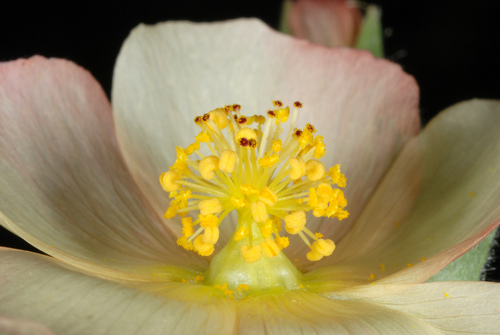
Members of the Malvaceae family are most easily identified by their distinctive flowers, which typically feature five unfused petals that often spiral slightly in a pinwheel fashion. A hallmark trait is the 'staminal column'—numerous stamens fused together into a central tube that vividly protrudes from the flower's center, creating a prominent landing pad for pollinators. Leaves are generally alternate and frequently have palmate venation or lobing, resembling an open hand. Just below the sepals, many species exhibit an epicalyx, a secondary whorl of leaf-like bracts. Plant forms span a massive spectrum, from fuzzy-leaved herbaceous creepers to giant trees with heavily swollen trunks.
Kategorie
PflanzenSeltenheit
Common
Gefahr
1/5 · Sehr gering
Snaps
Mach den ersten Snap!
African Baobabs, which belong to the Malvaceae family, have trunks so incredibly wide that hollowed-out living trees have historically been used as makeshift shelters, bars, and even small prisons.
Cotton, the world's most important natural textile fiber, comes from the fluffy, protective hairs surrounding the seeds of the Gossypium plant, a prominent mallow family member.
The famous 'marshmallow' originally comes from a plant in this family (Althaea officinalis), whose sweet, mucilaginous roots were once whipped into a sugary confection.
This incredible plant family gives us chocolate! The cacao tree produces large pods containing seeds that are fermented, roasted, and ground to create cocoa.
Plants in this family produce a thick, gooey substance called mucilage, which helps them retain water during droughts and deters herbivorous insects.
Many species fuse their stamens into an elongated central column, an ingenious structural adaptation that brushes pollen precisely onto the bodies of visiting pollinators.
Certain members of the family, most notably the baobab trees, are uniquely adapted to arid environments by storing thousands of gallons of water within their massive, swollen trunks.
As photosynthetic plants, members of the Malvaceae family produce their own energy by converting sunlight, carbon dioxide, and water into carbohydrates.
Archilochus colubris
Feeds heavily on the nectar of tubular Hibiscus flowers, facilitating critical pollination.
Anthonomus grandis
A notorious agricultural pest that feeds on and lays its eggs exclusively inside the fruiting bolls of cotton plants.
Danaus plexippus
Adult butterflies frequently visit mallow and hibiscus flowers to harvest nectar during their long migrations.
Für dieses Objekt sind noch keine Merkmal-Badges vergeben.
Sammlungen für dieses Objekt erscheinen hier, wenn weitere Themen hinzugefügt werden.
Gefahr
1/5 · Sehr gering
Noch keine besonderen Sicherheitshinweise.
Der einfachste Weg, Mallow And Hibiscus Family zu bestimmen, ist die Verwendung der Naturführer-App Snappit.
2-7000 cm
1-3000 Jahre
As photosynthetic plants, members of the Malvaceae family produce their own energy by converting sunlight, carbon dioxide, and water into carbohydrates.
Found across nearly all terrestrial ecosystems worldwide, they thrive particularly well in tropical rainforests, arid savannas, temperate meadows, coastal marshes, and heavily cultivated urban landscapes.
1-500
5-180 Tage
Zoome hinein, um Cluster aufzulösen und zu sehen, wo dieses Objekt fotografiert wurde.
Neueste Snaps erscheinen hier, wenn neue Beobachtungen hinzukommen.