

Mammoth Cave Crayfish
orconectes pellucidus
The Mammoth Cave Crayfish (Orconectes pellucidus) is a fascinating, ghostly-pale crustacean completely adapted to a subterranean life. Dwelling in the eternal darkness of underground rivers and pools beneath central Kentucky, this true troglobite has evolved uniquely to survive in a nutrient-poor, lightless world. Lacking both functional eyes and body pigmentation, it appears almost translucent, moving deliberately through cave waters using highly sensitive, elongated antennae to navigate and find food. Its extremely slow metabolism allows it to endure long periods without eating, making it a master of survival in the stark, beautiful depths of the Mammoth Cave system.
Lebensraum: Found exclusively in subterranean freshwater streams, clear pools, and aquifers within limestone karst cave systems.
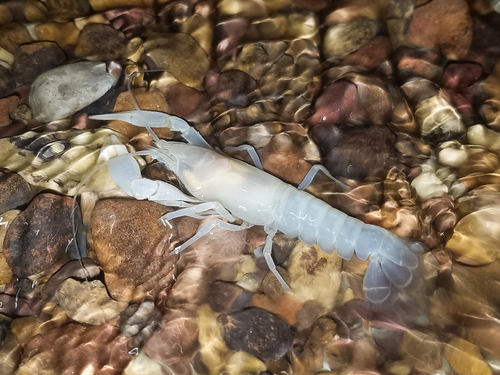
This small crayfish is entirely devoid of pigment, appearing white to semi-translucent, which sometimes allows its internal organs to be visible through the exoskeleton. It has rudimentary, vestigial eyestalks that lack corneas or visual pigments, rendering it completely blind. To compensate for its lack of sight, it possesses exceptionally long antennae and spindly, elongated walking legs covered in sensitive setae. Adults typically reach lengths of just 4 to 7 centimeters.
Kategorie
AnimalSeltenheit
Common
Gefahr
1/5 · Sehr gering
Snaps
Mach den ersten Snap!
Because they live in constant darkness, Mammoth Cave Crayfish have completely lost their functional eyes over thousands of generations of evolution.
They are so adapted to nutrient scarcity that they can survive up to a year without eating any food.
They have an exceptionally long lifespan for a crayfish, potentially living up to 30 years due to their incredibly slow, energy-conserving metabolism.
This species was one of the first cave-dwelling organisms ever described by Western science, originally documented in the 1840s.
Possesses elongated antennae covered in chemoreceptors and mechanoreceptors to navigate and detect prey in pitch-black water.
Maintains an incredibly slow metabolic rate, allowing it to survive for months without food in a nutrient-scarce cave environment.
Conserves energy by not producing melanin or other pigments, resulting in a ghostly white exoskeleton perfectly suited for absolute darkness.
It relies on organic matter that washes into the cave or is deposited by other animals, acting as an opportunistic scavenger.
Altersunterschiede: Juveniles may actively hunt smaller micro-invertebrates before transitioning to a largely scavenging diet as adults.
Myotis grisescens
Provides a vital nutrient source to the crayfish through the dropping of guano into cave streams.
Caecidotea stygia
Competes for food and occasionally preys upon smaller cave-dwelling crustaceans.
Typhlichthys subterraneus
Shares habitat and competes for limited food resources in underground pools.
Für dieses Objekt sind noch keine Merkmal-Badges vergeben.
Noch keine Alternativnamen vorhanden.
Sammlungen für dieses Objekt erscheinen hier, wenn weitere Themen hinzugefügt werden.
Gefahr
1/5 · Sehr gering
Noch keine besonderen Sicherheitshinweise.
Der einfachste Weg, Mammoth Cave Crayfish zu bestimmen, ist die Verwendung der Naturführer-App Snappit.
4-7 cm
0.002-0.015 kg
15-30 Jahre
1 km/h
It relies on organic matter that washes into the cave or is deposited by other animals, acting as an opportunistic scavenger.
Found exclusively in subterranean freshwater streams, clear pools, and aquifers within limestone karst cave systems.
Foraging
Zoome hinein, um Cluster aufzulösen und zu sehen, wo dieses Objekt fotografiert wurde.
Neueste Snaps erscheinen hier, wenn neue Beobachtungen hinzukommen.



