Mandrillus
Mandrillus
Mandrills are colorful monkeys that live in the forests of Africa. They have bright blue and red faces and are known for their playful nature and strong social bonds with their families.
Lebensraum: Forests
The Mandrillus has a striking face with deep grooves and a bright red stripe down its nose, flanked by blue ridges. Its rump is equally vibrant with shades of red, blue, and purple, and its body is covered in olive-green fur.
Kategorie
SäugetiereSeltenheit
Common
Gefahr
3/5 · Mittel
Snaps
Mach den ersten Snap!
Males' colors get even brighter when they are excited or showing off!
Mandrills store food in their cheek pouches for snacking later!
Their long canine teeth can grow up to 6.3 centimeters long!
They live in large groups called "hordes" that can have hundreds of members!
Mandrillus has a vivid face and rump that helps them send clear signals about their health and status to other mandrills.
Mandrillus can crush tough nuts and seeds because of their strong jaws and long, sharp canine teeth.
Mandrillus can sniff out hidden food like roots and insects because of their well-developed sense of smell.
Mandrills are omnivores, eating fruits, seeds, insects, and even small animals.
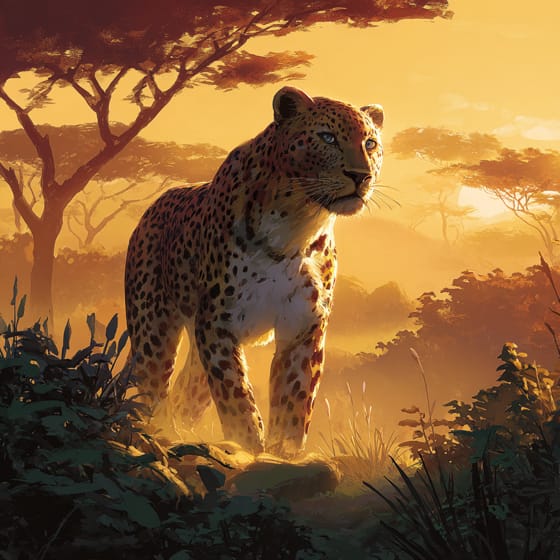
Panthera pardus
Leopards are a primary natural predator of mandrills.
Homo sapiens
Humans hunt mandrills for bushmeat and traditional medicine.
Ficus ovata
Mandrills frequently feed on the fruits and leaves of fig trees.
Dorylus fulvus
Mandrills consume various ant species, including driver ants.
Pelzig beschreibt Tiere, die eine dichte Schicht aus weichen Haaren oder Fell besitzen.
Soziale Tiere leben in organisierten Gruppen und kooperieren, um ihr Überleben zu sichern, beispielsweise bei der Nahrungssuche, Verteidigung und Aufzucht der Jungen.
Dieses Merkmal kennzeichnet Organismen, deren Ernährung sowohl pflanzliche als auch tierische Bestandteile umfasst.
Baumbewohnende Tiere leben hauptsächlich in Bäumen und nutzen diese als Unterschlupf, Nahrungsquelle und zum Schutz vor Raubtieren.

Farbenfroh beschreibt Organismen oder Objekte, die eine große Vielfalt an leuchtenden und deutlich erkennbaren Farben aufweisen.

Waldlebensräume sind terrestrische Lebensräume, die von dichtem Baumbestand dominiert werden und eine große Vielfalt an Pflanzen- und Tierarten beherbergen.

Dieses Merkmal kennzeichnet Lebewesen, die bei der Jagd, Flucht oder Fortbewegung eine außergewöhnliche Schnelligkeit aufweisen.

Tagaktive Tiere sind hauptsächlich bei Tageslicht aktiv und ruhen oder schlafen in der Regel nachts.

Der Status 'Stark gefährdet' bedeutet, dass eine Art in naher Zukunft einem sehr hohen Risiko ausgesetzt ist, in freier Wildbahn auszusterben.
Gefahr
3/5 · Mittel
Mandrills are wild animals and should be admired from a distance.
60-95 cm
10-37 kg
20-30 Jahre
40 km/h
Mandrills are omnivores, eating fruits, seeds, insects, and even small animals.
Forests
Foraging
1-2
Zoome hinein, um Cluster aufzulösen und zu sehen, wo dieses Objekt fotografiert wurde.
Neueste Snaps erscheinen hier, wenn neue Beobachtungen hinzukommen.