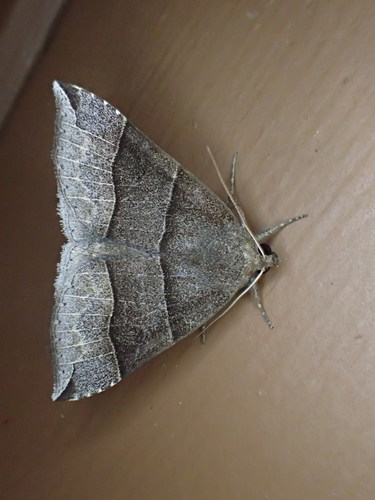


Maple Looper Moth
parallelia bistriaris
Meet the Maple Looper Moth, a fascinating nocturnal insect native to the rich deciduous forests of eastern North America. Belonging to the family Erebidae, this moth plays a quiet yet vital role in its woodland ecosystems. While the adults are elegant, cryptically colored flyers, it is the larval stage that often captures the attention of observers. The caterpillars are classic loopers or inchworms, moving with a charming looping gait that makes them look as if they are measuring the twigs they travel upon. Highly adapted to life among maple trees, they are masters of blending into their surroundings, seamlessly escaping the notice of predators. Their presence is a wonderful indicator of a healthy, biodiverse forest canopy, where they serve as an essential food source for nesting birds and nocturnal predators alike.
Lebensraum: Found in deciduous forests, mixed woodlands, and suburban areas rich in maple trees across eastern North America.
The adult Maple Looper Moth features a wingspan of approximately 3.5 to 4.5 centimeters. Its forewings are a warm, dusky grayish-brown, marked by two highly distinct, nearly straight pale lines that traverse the wing, bordered by a darker shade on the outer edge. The hindwings are a slightly lighter brownish-gray with a pale postmedial line. When resting flat against tree bark with its wings outstretched in a triangular shape, its intricate patterning provides excellent camouflage, mimicking the natural textures and shadows of tree bark.
Kategorie
InsektenSeltenheit
Common
Gefahr
1/5 · Sehr gering
Snaps
Mach den ersten Snap!
Adult moths can be found visiting sap leaks on maple trees, taking advantage of the same sugary fluid that humans harvest for maple syrup.
Despite being classified in the Erebidae family, its caterpillars move like loopers because they have reduced prolegs, a trait typical of Geometrid moths.
The species name 'bistriaris' translates to 'two-striped' in reference to the two distinct bands crossing its forewings.
The caterpillars can stiffen and hold their bodies at an angle from branches, perfectly mimicking small twigs to avoid detection by predators.
Like many erebid moths, they possess tympanic organs that can detect the high-frequency echolocation calls of insectivorous bats, allowing them to take evasive flight paths.
The wing patterns of the adult moth match the textures of tree bark, rendering them virtually invisible to day-hunting birds when resting.
The larvae feed strictly on the foliage of deciduous trees, while the adult moths feed on sweet organic liquids like flower nectar, tree sap, and rotting fruit fluids.
Altersunterschiede: Caterpillars are chewing folivores limited to maple leaves, whereas adults possess a proboscis to sip energy-rich nectar and tree fluids.
Acer rubrum
The caterpillars utilize this tree as their primary host plant, feeding extensively on its leaves.
Sayornis phoebe
This insectivorous bird actively hunts the caterpillars during the nesting season to feed its young.
Eptesicus fuscus
This nocturnal mammal preys upon adult moths caught flying in the forest canopy at night.
Für dieses Objekt sind noch keine Merkmal-Badges vergeben.
Noch keine Alternativnamen vorhanden.
Sammlungen für dieses Objekt erscheinen hier, wenn weitere Themen hinzugefügt werden.
Gefahr
1/5 · Sehr gering
Noch keine besonderen Sicherheitshinweise.
Der einfachste Weg, Maple Looper Moth zu bestimmen, ist die Verwendung der Naturführer-App Snappit.
2-3 cm
3-5 cm
0.0001-0.0003 kg
0-1 Jahre
15 km/h
The larvae feed strictly on the foliage of deciduous trees, while the adult moths feed on sweet organic liquids like flower nectar, tree sap, and rotting fruit fluids.
Found in deciduous forests, mixed woodlands, and suburban areas rich in maple trees across eastern North America.
Zoome hinein, um Cluster aufzulösen und zu sehen, wo dieses Objekt fotografiert wurde.
Neueste Snaps erscheinen hier, wenn neue Beobachtungen hinzukommen.








.jpg&width=800)





