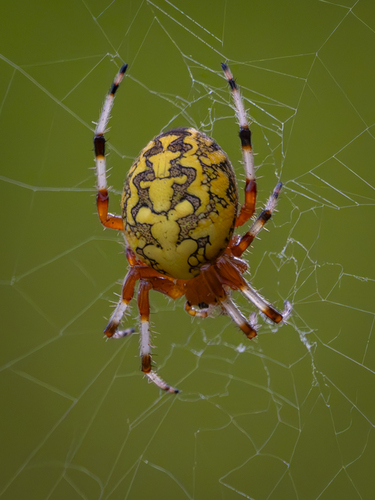


Marbled Orbweaver
araneus marmoreus
The Marbled Orbweaver (Araneus marmoreus) is a striking and highly variable spider best known for the spectacular, wheel-shaped webs it weaves in late summer and autumn. Sometimes affectionately called the pumpkin spider, the females of this species become especially noticeable in the fall when their abdomens swell with eggs, taking on vibrant orange hues. They belong to the family Araneidae, which represents the classic orb-weaving spiders. Rather than sitting exposed in the center of their webs, these spiders typically conceal themselves in a nearby silk-lined retreat, often fashioned from a folded leaf. Found throughout the Northern Hemisphere, they play an essential role in their ecosystems by naturally controlling insect populations. Despite their large size and somewhat imposing Halloween-ready appearance, Marbled Orbweavers are harmless to humans. Their intricate webs, fascinating hunting techniques, and seasonal color displays make them a favorite subject for nature enthusiasts.
Lebensraum: Found primarily in moist, wooded environments such as deciduous forests, tall grasses, shrublands, and woodland edges, often hiding within a folded leaf near their web.
This species exhibits extreme color variation, but the most common form features a large, bulbous, pale yellow or vibrant orange abdomen heavily mottled with intricate brown, purple, or black marbling. The cephalothorax ranges from pale yellow to burnt orange, typically featuring central dark lines. Their legs are highly noticeable, strongly banded with striking rings of red-orange, black, and white. Females are significantly larger, measuring between 9 and 20 millimeters in body length, while the much smaller males typically measure 6 to 9 millimeters. An alternative morph, known as variety pyramidatus, is almost entirely pale yellow with a single, distinct dark brown patch toward the rear of the abdomen.
Kategorie
InvertebrateSeltenheit
Common
Gefahr
1/5 · Sehr gering
Snaps
Mach den ersten Snap!
Because the females swell up with eggs in the autumn and sport bright orange, marbled abdomens, they are widely known by the nickname pumpkin spider.
Despite spinning beautiful, symmetrical webs, they rarely sit in the middle of them, preferring to hide in a nearby leaf with one foot resting on a telegraph wire to feel vibrations.
There is a rare, pale-yellow color morph of this spider known as variety pyramidatus, which looks so radically different it was originally thought to be an entirely separate species.
When winter approaches, the adult female lays a large silk egg sac containing hundreds of eggs, which overwinter and hatch the following spring long after she passes away.
Rather than sitting exposed on the web, it builds a concealed hideout inside a folded or tied leaf nearby.
It maintains a specialized line of silk connecting its hidden retreat to the center of the web, allowing it to feel the vibrations of trapped prey.
Like many orbweavers, it regularly consumes its own web to recycle the valuable silk proteins before spinning a fresh one.
The Marbled Orbweaver feeds on a wide variety of flying and jumping insects that become entangled in its sticky web.
Altersunterschiede: Spiderlings eat much smaller prey such as aphids and gnats, scaling up to large hymenopterans and lepidopterans as adults.
Apis mellifera
Preys on foraging insects that become trapped in its web.
Sceliphron caementarium
Hunted and paralyzed by solitary wasps to serve as living food for their developing larvae.
Poecile atricapillus
Often eaten by small insectivorous woodland birds searching through foliage.
Für dieses Objekt sind noch keine Merkmal-Badges vergeben.
Noch keine Alternativnamen vorhanden.
Sammlungen für dieses Objekt erscheinen hier, wenn weitere Themen hinzugefügt werden.
Gefahr
1/5 · Sehr gering
Noch keine besonderen Sicherheitshinweise.
Der einfachste Weg, Marbled Orbweaver zu bestimmen, ist die Verwendung der Naturführer-App Snappit.
1-2 cm
0.0001-0.001 kg
1 Jahre
The Marbled Orbweaver feeds on a wide variety of flying and jumping insects that become entangled in its sticky web.
Found primarily in moist, wooded environments such as deciduous forests, tall grasses, shrublands, and woodland edges, often hiding within a folded leaf near their web.
Ambush
300-500
Zoome hinein, um Cluster aufzulösen und zu sehen, wo dieses Objekt fotografiert wurde.
Neueste Snaps erscheinen hier, wenn neue Beobachtungen hinzukommen.










.jpg&width=800)









