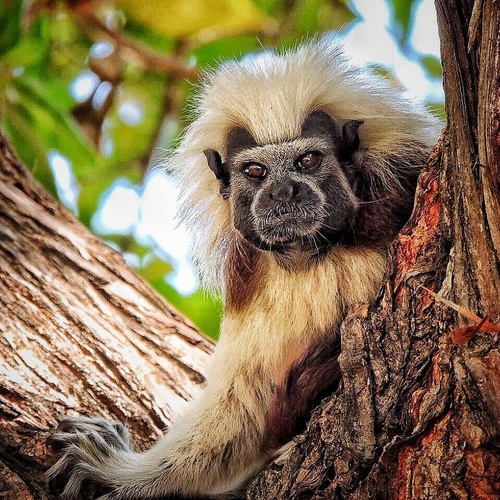


Marmosets And Tamarins
callitrichidae
Marmosets and tamarins, belonging to the family Callitrichidae, are captivating New World monkeys renowned for their diminutive size and complex social structures. These highly arboreal primates are characterized by their rapid movements and close-knit family groups, often consisting of a dominant breeding pair and their offspring, as well as other non-breeding adults. They exhibit unique reproductive strategies, including a high incidence of twin births and extensive cooperative care where multiple group members assist in raising the young, making them a fascinating subject for primatological study.
Lebensraum: Found primarily in the tropical and subtropical rainforests of Central and South America, as well as dry forests and secondary growth, often thriving in the mid to upper canopy layers.
Marmosets and tamarins are small primates, typically ranging from 13 to 30 centimeters in body length, excluding their long, non-prehensile tails that can be even longer than their bodies. Their fur coloration is highly diverse across species, often featuring striking patterns of black, white, brown, and gold, sometimes with distinctive tufts around their ears or manes. Unlike other monkeys, they possess claw-like nails (tegulae) on all digits except the great toe, which helps them cling to vertical tree trunks, along with specialized teeth adapted for gouging tree bark.
Kategorie
SäugetiereSeltenheit
Common
Gefahr
1/5 · Sehr gering
Snaps
Mach den ersten Snap!
Fathers and other non-breeding group members play a crucial role in raising the young, often carrying infants on their backs from birth.
Many species are known for their 'gummivory,' using specialized teeth to gouge holes in tree bark and feed on nutritious tree sap and gum.
Marmosets and tamarins are considered among the smallest true monkeys in the world, with some species weighing less than a can of soda.
Unlike most other primates, they commonly give birth to twins, a reproductive strategy that benefits from their cooperative breeding system.
Marmosets and tamarins possess specialized claw-like nails (tegulae) on their fingers and toes, enabling them to cling effectively to vertical tree trunks and branches, a key adaptation for their arboreal lifestyle.
These primates exhibit a unique social system where not only the parents but also other adult group members actively participate in carrying, feeding, and protecting the infants, significantly increasing offspring survival rates.
Many species have specialized incisors and strong jaw muscles that allow them to gouge holes in tree bark to extract and feed on nutritious tree sap, gum, and other exudates, especially during periods when fruit and insects are scarce.
Marmosets and tamarins have a diverse omnivorous diet, primarily consisting of insects, fruits, and tree exudates such as sap and gum. They are opportunistic feeders, adapting their diet based on seasonal availability.
Harpia harpyja
Major avian predator in their habitat, preying on arboreal mammals.
Leopardus pardalis
Terrestrial and arboreal feline predator found in their range.
Ficus spp.
Consume fruits and aid in seed dispersal, contributing to forest regeneration.
Formicidae
Significant prey item, especially during the dry season when other food sources are scarce.
Für dieses Objekt sind noch keine Merkmal-Badges vergeben.
Sammlungen für dieses Objekt erscheinen hier, wenn weitere Themen hinzugefügt werden.
Gefahr
1/5 · Sehr gering
Noch keine besonderen Sicherheitshinweise.
Der einfachste Weg, Marmosets And Tamarins zu bestimmen, ist die Verwendung der Naturführer-App Snappit.
13-30 cm
0.1-0.7 kg
10-18 Jahre
25 km/h
Marmosets and tamarins have a diverse omnivorous diet, primarily consisting of insects, fruits, and tree exudates such as sap and gum. They are opportunistic feeders, adapting their diet based on seasonal availability.
Found primarily in the tropical and subtropical rainforests of Central and South America, as well as dry forests and secondary growth, often thriving in the mid to upper canopy layers.
Foraging
Zoome hinein, um Cluster aufzulösen und zu sehen, wo dieses Objekt fotografiert wurde.
Neueste Snaps erscheinen hier, wenn neue Beobachtungen hinzukommen.