

Marsh Calla
calla palustris
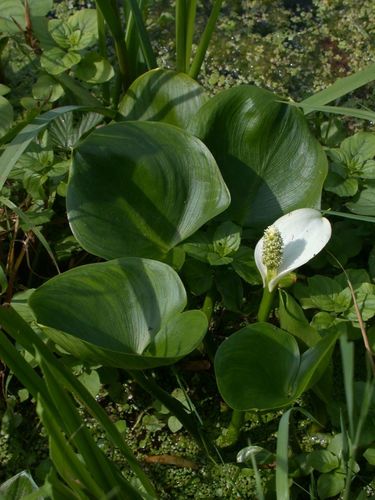
The Marsh Calla (Calla palustris) is a captivating wetland plant, uniquely the sole species within its genus. This perennial herbaceous plant is admired for its striking, waxy white spathe that cradles a yellow spadix, creating an elegant floral display. Beyond its beauty, the Marsh Calla plays a crucial role in its boggy habitats, providing cover and food sources for various small creatures, despite its inherent toxicity. It thrives in cold, nutrient-poor waters, a testament to its robust adaptations for challenging wetland environments, making it a fascinating subject for nature enthusiasts and botanists alike.
Lebensraum: Found in bogs, marshes, swamps, wet woodlands, and along the muddy shores of ponds and slow-moving streams.
The Marsh Calla is easily identified by its prominent, pure white, petal-like bract (spathe) that wraps around a yellow, finger-like spadix covered in tiny true flowers. Its glossy, dark green leaves are distinctly heart-shaped (cordate) and can be up to 15-20 cm long, typically arising on long petioles. After flowering, the plant produces clusters of bright red, fleshy berries. It generally grows to a height of 20 to 40 centimeters, often forming dense colonies along water margins.
Kategorie
PflanzenSeltenheit
Common
Gefahr
1/5 · Sehr gering
Snaps
Mach den ersten Snap!
Despite its beauty, all parts of the Marsh Calla are toxic due to calcium oxalate crystals, which can cause severe irritation if ingested.
It is the only species in the genus Calla, highlighting its unique evolutionary path within the Araceae family.
Its bright red berries are attractive to birds, which helps in seed dispersal, but these berries are also toxic to humans and many animals.
The 'flower' of the Marsh Calla is actually a spathe, a modified leaf that surrounds a central stalk of tiny true flowers called a spadix.
The Marsh Calla is extremely tolerant of cold climates, allowing it to thrive in northern temperate and subarctic regions where many other wetland plants cannot.
All parts of the plant contain calcium oxalate crystals, making it toxic if ingested and deterring most herbivores from consuming it.
It spreads effectively through creeping rhizomes, forming dense colonies that help stabilize wetland soils and outcompete other vegetation in its niche.
As a photosynthetic organism, the Marsh Calla produces its own food by converting light energy into chemical energy, utilizing carbon dioxide, water, and essential nutrients from its environment.
Anas platyrhynchos
Habitat and occasional food source (berries)
Ondatra zibethicus
Habitat creation and soil stabilization for wetland inhabitants
Thanatophilus lapponicus
Pollination of flowers
Deroceras laeve
Limited herbivory, primarily on leaves (despite toxicity)
Für dieses Objekt sind noch keine Merkmal-Badges vergeben.
Noch keine Alternativnamen vorhanden.
Sammlungen für dieses Objekt erscheinen hier, wenn weitere Themen hinzugefügt werden.
Gefahr
1/5 · Sehr gering
Noch keine besonderen Sicherheitshinweise.
Der einfachste Weg, Marsh Calla zu bestimmen, ist die Verwendung der Naturführer-App Snappit.
20-40 cm
5-15 Jahre
As a photosynthetic organism, the Marsh Calla produces its own food by converting light energy into chemical energy, utilizing carbon dioxide, water, and essential nutrients from its environment.
Found in bogs, marshes, swamps, wet woodlands, and along the muddy shores of ponds and slow-moving streams.
4-10
Zoome hinein, um Cluster aufzulösen und zu sehen, wo dieses Objekt fotografiert wurde.
Neueste Snaps erscheinen hier, wenn neue Beobachtungen hinzukommen.




_-_Flickr_-_brewbooks.jpg&width=800)