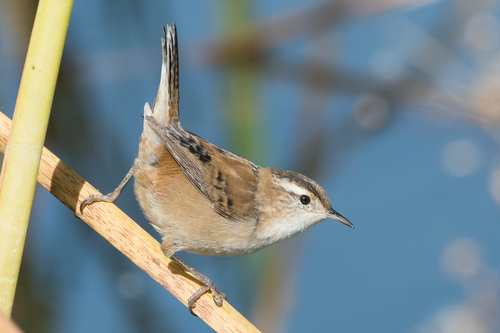


Marsh Wren
cistothorus palustris
The Marsh Wren is a tiny, energetic songbird renowned for its remarkably loud and bubbly voice, which can fill an entire wetland with mechanical, rattling trills. Found clinging tightly to reeds and cattails, this secretive bird is far more often heard than seen. It spends its days hopping actively through dense marsh vegetation, searching for small invertebrates and defending its territory with endless vigor. An intriguing aspect of Marsh Wren behavior is the male's industrious nest-building habit. During the breeding season, a single male will construct up to a dozen dome-shaped dummy nests woven from grass and cattails. These decoy nests serve to attract females, confuse predators, and mark territory boundaries, demonstrating the incredible resourcefulness of this diminutive wetland specialist.
Lebensraum: Found in dense, standing emergent vegetation of freshwater and saltwater marshes, particularly among cattails, rushes, and reeds.
The Marsh Wren is a small, plump bird with a thin, slightly down-curved bill and a tail that it characteristically cocks upright. It is clad in warm brown upperparts, featuring a distinct black-and-white streaked triangular patch on its upper back. A prominent white stripe runs above each eye, contrasting with a dark crown. Its underparts are mostly pale, fading to buffy brown along the flanks. They measure around 10 to 14 centimeters in length with a short, rounded wingspan.
Kategorie
VögelSeltenheit
Common
Gefahr
1/5 · Sehr gering
Snaps
Mach den ersten Snap!
A male Marsh Wren may build up to 14 nests in a single breeding season, but only one is actually used to raise young.
Marsh Wrens are notoriously aggressive and will sometimes destroy the eggs of neighboring birds, including other Marsh Wrens or Red-winged Blackbirds, to reduce competition.
Their song is so loud and persistent that they have been known to sing all through the night, especially during the spring breeding season.
Males construct multiple dummy nests to mislead predators and showcase nesting territory to potential mates.
Equipped with strong feet and legs, they can grasp two separate vertical reed stems simultaneously to remain stable in high marsh winds.
They possess an exceptionally large vocal repertoire, capable of singing over one hundred distinct, rapid-fire song variations to defend territories.
Feeds primarily on a wide variety of aquatic and terrestrial insects, spiders, and tiny aquatic invertebrates found near the water's surface.
Molothrus ater
Lays eggs in the Marsh Wren's nests, forcing the wrens to raise their young.
Oryzomys palustris
Raids nests to consume the eggs and vulnerable nestlings of the Marsh Wren.
Agelaius phoeniceus
Competes intensely for nesting territories and food resources in the same marsh ecosystems.
Für dieses Objekt sind noch keine Merkmal-Badges vergeben.
Noch keine Alternativnamen vorhanden.
Sammlungen für dieses Objekt erscheinen hier, wenn weitere Themen hinzugefügt werden.
Gefahr
1/5 · Sehr gering
Noch keine besonderen Sicherheitshinweise.
Der einfachste Weg, Marsh Wren zu bestimmen, ist die Verwendung der Naturführer-App Snappit.
10+ cm
15+ cm
0.009+ kg
1+ Jahre
25 km/h
Feeds primarily on a wide variety of aquatic and terrestrial insects, spiders, and tiny aquatic invertebrates found near the water's surface.
Found in dense, standing emergent vegetation of freshwater and saltwater marshes, particularly among cattails, rushes, and reeds.
Zoome hinein, um Cluster aufzulösen und zu sehen, wo dieses Objekt fotografiert wurde.
Neueste Snaps erscheinen hier, wenn neue Beobachtungen hinzukommen.









.jpg&width=800)


.jpg&width=800)



