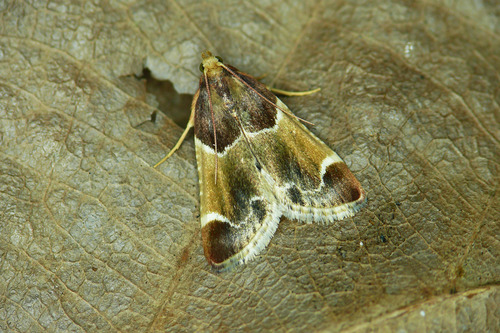


Meal Moth
pyralis farinalis
The Meal Moth (Pyralis farinalis), often recognized as a common inhabitant of granaries and pantries, is a small but beautifully patterned moth belonging to the family Pyralidae. Despite its reputation as a household pest, this insect boasts a fascinating life cycle and a remarkably intricate pattern on its wings that mimics dried leaves and detritus, helping it blend into its surroundings. As larvae, these industrious caterpillars spin silken tubes within their food sources, feeding on stored grains, flour, and organic debris. This cosmopolitan species has traveled alongside humans for centuries, utilizing agricultural trade to establish itself globally. Whether encountered fluttering around a dimly lit kitchen or resting quietly on an old sack of grain, the Meal Moth offers a close-up look at how insects have masterfully adapted to live alongside human civilization, finding sustenance and shelter in our most basic agricultural staples.
Lebensraum: Found globally in grain stores, pantries, barns, and mills where dried organic materials and cereal products are abundant.
The adult Meal Moth is easily identified by its distinctive tri-colored forewings, which are divided into distinct bands. The base and the outer tip of the wing are a rich, dark reddish-brown, while the broad middle section is a contrasting pale olive or buff color. These bands are separated by thin, wavy white lines. When at rest, the moth typically holds its wings flat against its body and curiously curves its abdomen upwards at a sharp angle. Its wingspan ranges from 1.8 to 3.0 centimeters, and its legs are relatively long and pale, complementing its complex, tapestry-like wing pattern.
Kategorie
InsektenSeltenheit
Common
Gefahr
1/5 · Sehr gering
Snaps
Mach den ersten Snap!
Adult Meal Moths rest in a very peculiar banana-like shape, tilting their wings and tail upwards at almost a ninety-degree angle.
The Meal Moth has earned the nickname 'Meal Snout' due to its prominent palps that look like a small snout or beak protruding from its head.
Unlike many other moth caterpillars, Meal Moth larvae spin silken tubes to live inside, effectively weaving their food into their home.
As caterpillars, they spin protective silken tubes mixed with food particles and frass, shielding themselves from predators and dry environments while they feed.
Adults habitually curve their abdomen upwards when at rest, a unique posture that may help disrupt their silhouette and deter potential predators.
Larvae possess specialized gut enzymes allowing them to digest dry, low-moisture starch and grains, enabling survival in challenging, arid microclimates.
Larvae feed on a wide variety of dry plant-based materials, while adults have non-functional or highly reduced mouthparts and generally do not feed.
Habrobracon hebetor
This beneficial parasitoid wasp lays its eggs on the larvae of the meal moth, paralyzing them to feed its offspring.
Tenebrio molitor
Competes directly with meal moth larvae for food resources within stored grain and cereal products.
Passer domesticus
Opportunistically preys upon adult meal moths resting on the exteriors of barns and silos.
Für dieses Objekt sind noch keine Merkmal-Badges vergeben.
Noch keine Alternativnamen vorhanden.
Sammlungen für dieses Objekt erscheinen hier, wenn weitere Themen hinzugefügt werden.
Gefahr
1/5 · Sehr gering
Noch keine besonderen Sicherheitshinweise.
Der einfachste Weg, Meal Moth zu bestimmen, ist die Verwendung der Naturführer-App Snappit.
1-2 cm
2-3 cm
0.0001-0.0003 kg
0-1 Jahre
8 km/h
Larvae feed on a wide variety of dry plant-based materials, while adults have non-functional or highly reduced mouthparts and generally do not feed.
Found globally in grain stores, pantries, barns, and mills where dried organic materials and cereal products are abundant.
Zoome hinein, um Cluster aufzulösen und zu sehen, wo dieses Objekt fotografiert wurde.
Neueste Snaps erscheinen hier, wenn neue Beobachtungen hinzukommen.
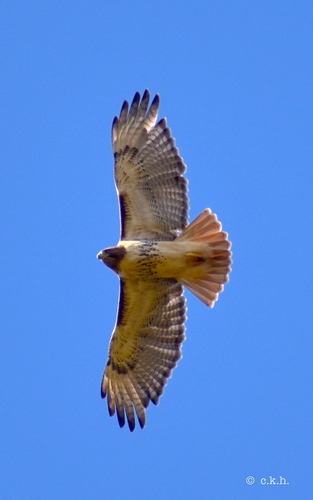
New Hampshire, US
Hier kann man sehen Rotschwanzbussard, Rotkardinal und Zuckersperling.
Führer anzeigen →

South Carolina, US
Hier kann man sehen Grüne Klee-Eule und Schwarzpunkt-Rostmotte.
Führer anzeigen →



















