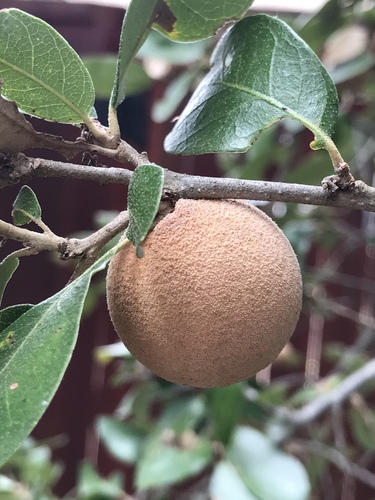


Mealy Oak Gall Wasp
disholcaspis cinerosa
The Mealy Oak Gall Wasp is a remarkable, tiny architect of the insect world, best known not for its physical appearance, but for the prominent, spherical homes it forces trees to build. Native to North America, particularly the southern United States, this fascinating cynipid wasp specializes in manipulating the cellular growth of live oaks. By injecting specialized venom and laying its eggs in the twigs, it induces the tree to grow a protective, nutrient-rich gall around the developing larva. These distinctive galls look like small, powdery marbles clinging to the branches. While the wasp itself goes largely unnoticed due to its minuscule size and fleeting adult lifespan, its galls are a familiar sight in parks and woodlands. The complex life cycle of the Mealy Oak Gall Wasp, which includes alternating generations of sexual and asexual reproduction, makes it a true marvel of evolutionary biology.
Lebensraum: Found primarily in oak woodlands, suburban parks, and urban landscapes where their host plants, particularly live oaks, are abundant.
Adult Mealy Oak Gall Wasps are tiny, measuring only about 2 to 4 millimeters in length, with dark brown or black bodies, transparent wings, and a distinctive humpbacked profile typical of cynipid wasps. Their abdomens are laterally compressed and shiny. However, the most reliable way to identify this species is through the galls it produces: spherical growths on oak twigs ranging from 12 to 25 millimeters in diameter. These galls are initially soft and pinkish but harden and turn tan or gray, covered in a distinctive white, powdery, mealy substance that gives the species its name.
Kategorie
InsektenSeltenheit
Common
Gefahr
1/5 · Sehr gering
Snaps
Mach den ersten Snap!
Despite looking like a harmful disease to the tree, mealy oak galls cause virtually no long-term damage to the health of the host live oak, acting more like a mild cosmetic blemish.
Each powdery gall serves as a self-contained micro-ecosystem, often hosting not just the original wasp larva, but also other squatter insects, fungi, and parasites.
Like many oak galls, the mealy galls are rich in tannic acid, a compound historically harvested from similar galls to produce permanent iron gall ink used in medieval manuscripts.
The life cycle of the Mealy Oak Gall Wasp features an alternation of generations: a sexual spring generation that creates tiny galls on buds, and a larger asexual fall generation that creates the famous mealy galls.
Through a complex mix of chemical secretions and mechanical stimulation, females force oak trees to grow specialized, protective tissue spheres around their eggs.
The wasp exhibits a complex life cycle featuring alternating generations, including an all-female generation capable of reproducing asexually without mating.
The galls they induce secrete chemicals that not only hijack the tree's resources but also help deter certain predators from eating the vulnerable larvae inside.
As larvae, they feed exclusively on the nutrient-rich inner tissue of the oak galls they induce; adults rarely feed, focusing solely on reproduction.
Altersunterschiede: Larvae are entirely reliant on gall tissue; adults have vestigial mouthparts and generally do not feed.
Quercus virginiana
Relies entirely on this tree to form its protective galls.
Dryobates pubescens
These birds occasionally break open the hard winter galls to eat the wasp larvae inside.
Synergus spp.
These inquiline wasps lay their eggs in the mealy oak galls, competing with the host larvae for food and space.
Für dieses Objekt sind noch keine Merkmal-Badges vergeben.
Noch keine Alternativnamen vorhanden.
Sammlungen für dieses Objekt erscheinen hier, wenn weitere Themen hinzugefügt werden.
Gefahr
1/5 · Sehr gering
Noch keine besonderen Sicherheitshinweise.
Der einfachste Weg, Mealy Oak Gall Wasp zu bestimmen, ist die Verwendung der Naturführer-App Snappit.
1 cm
1 cm
0.00001-0.00005 kg
0-1 Jahre
As larvae, they feed exclusively on the nutrient-rich inner tissue of the oak galls they induce; adults rarely feed, focusing solely on reproduction.
Found primarily in oak woodlands, suburban parks, and urban landscapes where their host plants, particularly live oaks, are abundant.
Foraging
Zoome hinein, um Cluster aufzulösen und zu sehen, wo dieses Objekt fotografiert wurde.
Neueste Snaps erscheinen hier, wenn neue Beobachtungen hinzukommen.













.jpg&width=800)


