

Mealybug Destroyer
cryptolaemus montrouzieri
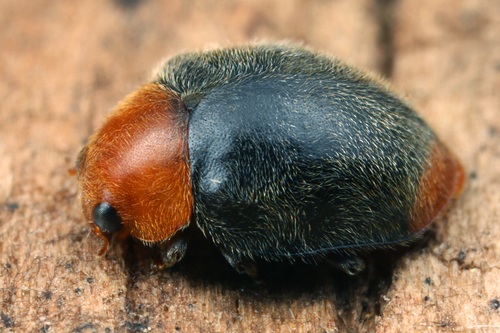
The Mealybug Destroyer (Cryptolaemus montrouzieri) is a tiny but formidable lady beetle famous for its role as a natural biological control agent. Native to Australia, this helpful insect has been introduced to citrus groves, orchards, and greenhouses worldwide to combat devastating mealybug infestations. Both the adults and larvae are aggressive predators of scale insects, making them beloved allies of gardeners and farmers alike. What makes this beetle truly fascinating is its larval stage, which employs a brilliant evolutionary trick: it mimics the appearance of its prey to move undetected through mealybug colonies, avoiding the wrath of protective ants. Engaging and highly active, they are a testament to the power of natural pest management.
Lebensraum: Found in agricultural fields, orchards, gardens, and greenhouses, particularly where mealybugs and scale insects are present on host plants.
Adult Mealybug Destroyers are small, convex beetles measuring about 3 to 4 millimeters in length. They feature a distinct coloration with a dark brown or black body paired with a reddish-orange head, thorax, and abdominal tip. The larvae, however, look vastly different and are often mistaken for their prey; they grow up to 1.3 centimeters long and are completely covered in woolly, white, waxy filaments that extend from their bodies, successfully disguising them as large mealybugs.
Kategorie
InsektenSeltenheit
Common
Gefahr
1/5 · Sehr gering
Snaps
Mach den ersten Snap!
A single larva can devour more than 250 mealybugs before transitioning into its pupal and adult stages.
The larval Mealybug Destroyer wears a 'wolf in sheep's clothing' disguise, using waxy white secretions to blend in perfectly with the very pests it eats.
This beetle was first brought from Australia to California in 1891 by biological control pioneer Albert Koebele to rescue the state's failing citrus groves.
The larval stage grows waxy white filaments that closely mimic the appearance of mealybugs, allowing them to infiltrate colonies and evade guardian ants.
Both larvae and adults possess an insatiable appetite, capable of eating hundreds of mealybugs during their short lifespans.
When threatened, adult beetles can exude a toxic, foul-smelling yellow fluid from their joints to deter potential predators.
Feeds almost exclusively on mealybugs and soft scale insects, actively hunting them across host plants.
Planococcus citri
Serves as the primary food source and prey for both larvae and adult beetles.
Linepithema humile
Ants defend mealybug colonies to harvest honeydew and will actively attack adult beetles.
Für dieses Objekt sind noch keine Merkmal-Badges vergeben.
Noch keine Alternativnamen vorhanden.
Sammlungen für dieses Objekt erscheinen hier, wenn weitere Themen hinzugefügt werden.
Gefahr
1/5 · Sehr gering
Noch keine besonderen Sicherheitshinweise.
Der einfachste Weg, Mealybug Destroyer zu bestimmen, ist die Verwendung der Naturführer-App Snappit.
Feeds almost exclusively on mealybugs and soft scale insects, actively hunting them across host plants.
Found in agricultural fields, orchards, gardens, and greenhouses, particularly where mealybugs and scale insects are present on host plants.
Foraging
Zoome hinein, um Cluster aufzulösen und zu sehen, wo dieses Objekt fotografiert wurde.
Neueste Snaps erscheinen hier, wenn neue Beobachtungen hinzukommen.