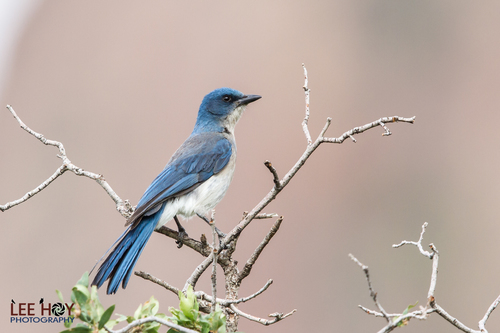


Mexican Jay
aphelocoma wollweberi
The Mexican Jay is a highly social, intelligent songbird native to the oak-pine woodlands of the southwestern United States and Mexico. Unlike many other jays, Mexican Jays live in complex, stable family groups of up to 25 individuals. These flocks defend year-round territories and practice cooperative breeding, where non-breeding helpers assist in raising the nestlings of dominant pairs. This collaborative behavior creates fascinating, highly vocal community dynamics that make them a delight for birdwatchers to observe.
Lebensraum: Found primarily in montane pine-oak woodlands, canyon bottoms, and evergreen forests of Mexico and the southwestern United States.
This medium-sized, sleek jay features a brilliant, dull-blue back, wings, and tail, contrasted by a pale gray breast and belly. Unlike the related Western Scrub-Jay, the Mexican Jay has a mostly uniform gray-blue head without a strong white eyebrow or dark breast band. Its bill is heavy, black, and straight, and its eyes are dark. Adults are uniform in color, whereas juveniles can be distinguished by their distinctive pinkish or pale-based lower mandibles, which darken as they mature.
Kategorie
VögelSeltenheit
Common
Gefahr
1/5 · Sehr gering
Snaps
Mach den ersten Snap!
Juvenile Mexican Jays have a distinctive pale or pinkish bill that gradually turns fully black as they reach adulthood.
Like other corvids, they have exceptional cognitive abilities, including recognizing individual humans and remembering the locations of thousands of hidden seeds.
Mexican Jays are highly social and form stable flocks of up to 25 individuals that stay together and defend territory year-round.
Non-breeding flock members actively assist in feeding, defending, and incubating the young of dominant pairs to increase chick survival rates.
They possess an extraordinary spatial memory that allows them to bury thousands of acorns each autumn and retrieve them months later during winter.
They use a wide repertoire of harsh scold calls, soft rattles, and mimicry to coordinate group movements and warn flock members of predators.
A highly opportunistic omnivore, eating a varied diet of nuts, seeds, insects, and small vertebrates depending on seasonal availability.
Accipiter cooperii
The Cooper's Hawk is a major aerial predator of adult and juvenile Mexican Jays, prompting complex alarm call networks.
Quercus arizonica
The jay feeds heavily on its acorns and acts as a key seed disperser by caching them in the ground, facilitating forest regeneration.
Molothrus ater
Occasionally attempts to parasitize Mexican Jay nests, though the jay's cooperative nest defense highly limits success.
Für dieses Objekt sind noch keine Merkmal-Badges vergeben.
Noch keine Alternativnamen vorhanden.
Sammlungen für dieses Objekt erscheinen hier, wenn weitere Themen hinzugefügt werden.
Gefahr
1/5 · Sehr gering
Noch keine besonderen Sicherheitshinweise.
Der einfachste Weg, Mexican Jay zu bestimmen, ist die Verwendung der Naturführer-App Snappit.
28+ cm
39+ cm
0.1+ kg
10+ Jahre
40 km/h
A highly opportunistic omnivore, eating a varied diet of nuts, seeds, insects, and small vertebrates depending on seasonal availability.
Found primarily in montane pine-oak woodlands, canyon bottoms, and evergreen forests of Mexico and the southwestern United States.
Zoome hinein, um Cluster aufzulösen und zu sehen, wo dieses Objekt fotografiert wurde.
Neueste Snaps erscheinen hier, wenn neue Beobachtungen hinzukommen.

Arizona, US
Hier kann man sehen Yarrow's Spiny Lizard und Mexican Jay.
Führer anzeigen →

Arizona, US
Hier kann man sehen Mexican Jay, Yarrow's Spiny Lizard und Weißwedelhirsch.
Führer anzeigen →

Arizona, US
Hier kann man sehen Broad-Billed Hummingbird und Mexican Jay.
Führer anzeigen →








_with_offspring%2C_Liefdefjord%2C_Svalbard.jpg&width=800)







_(27279453011).jpg&width=800)