

Miami Mist
phacelia purshii
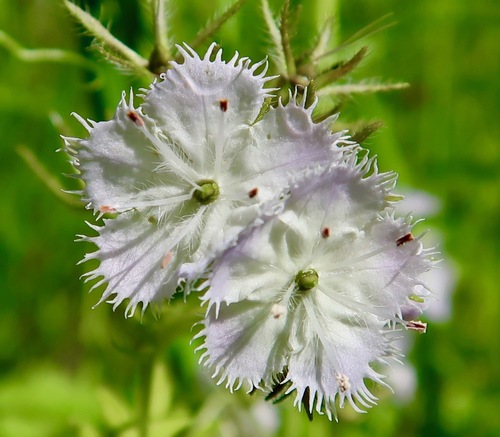
Miami Mist (Phacelia purshii) is a delicate, eye-catching annual wildflower native to the eastern and central regions of North America. Renowned for its stunning carpet-like blooms, it blankets rich, moist forest floors, alluvial woods, and shaded stream banks in late spring. Its unique, fringed blue-lavender petals create a beautiful misty haze across the woodland floor, which is how it earned its poetic common name. While technically an annual, it readily self-seeds to form dense, persistent colonies in favorable environments. As a key early-season resource, it plays an important role in supporting local pollinator populations, attracting a diverse array of bees, butterflies, and other beneficial insects before the dense forest canopy fully closes.
Lebensraum: Typically found in rich, moist deciduous woods, floodplains, and alluvial valleys, often growing in shaded areas near streams.
This low-growing herbaceous plant typically reaches heights of 15 to 50 centimeters. It is easily recognized by its distinctive flowers, which feature five deeply fringed petals ranging in color from pale lavender-blue to nearly white, centered around a light cream or white eye. The leaves are deeply, pinnately lobed and arranged alternately along light green, hairy stems. The visual effect of thousands of these fringed, pale blossoms clustered together resembles a low-lying, pastel-hued fog floating just above the leaf litter.
Kategorie
PflanzenSeltenheit
Common
Gefahr
1/5 · Sehr gering
Snaps
Mach den ersten Snap!
Despite its common name, Miami Mist is not native to Miami, Florida; it is named after the Miami River valley in Ohio where it grows in abundance.
The fringed margins of the petals are highly unusual among native wildflowers, giving the plants a unique 'tattered silk' appearance up close.
The plant's genus name, Phacelia, comes from the Greek word 'phakelos', meaning bundle, which refers to the clustered arrangement of its flowers.
The deeply fringed margins of its petals help diffuse light, attract specific native bees, and guide pollinators directly to the nectar-producing center.
It undergoes rapid growth and flowering in early spring, successfully producing seeds before the forest canopy closes and blocks vital sunlight.
The stems and leaves are covered in fine, bristly hairs that deter crawling herbivorous insects and help retain moisture.
As a photoautotrophic plant, Miami Mist produces its own organic nutrients using sunlight, water, and carbon dioxide through the process of photosynthesis.
Papilio glaucus
Feeds on nectar and assists in pollination during the spring bloom.
Apis mellifera
Collects nectar and pollen, acting as a primary early-season pollinator.
Odocoileus virginianus
Occasionally grazes on the succulent foliage of early spring forest plants.
Für dieses Objekt sind noch keine Merkmal-Badges vergeben.
Noch keine Alternativnamen vorhanden.
Sammlungen für dieses Objekt erscheinen hier, wenn weitere Themen hinzugefügt werden.
Gefahr
1/5 · Sehr gering
Noch keine besonderen Sicherheitshinweise.
Der einfachste Weg, Miami Mist zu bestimmen, ist die Verwendung der Naturführer-App Snappit.
15-50 cm
1 Jahre
As a photoautotrophic plant, Miami Mist produces its own organic nutrients using sunlight, water, and carbon dioxide through the process of photosynthesis.
Typically found in rich, moist deciduous woods, floodplains, and alluvial valleys, often growing in shaded areas near streams.
Zoome hinein, um Cluster aufzulösen und zu sehen, wo dieses Objekt fotografiert wurde.
Neueste Snaps erscheinen hier, wenn neue Beobachtungen hinzukommen.

















