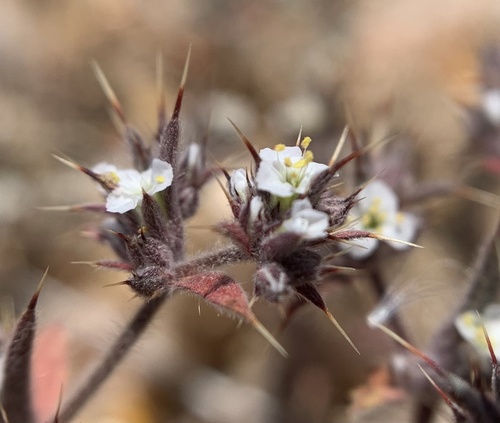


Mojave Spineflower
chorizanthe spinosa
The Mojave Spineflower (Chorizanthe spinosa) is a fascinating annual herb native to the arid expanses of the western Mojave Desert in California. This resilient plant has adapted to thrive in harsh, nutrient-poor sandy soils where temperatures fluctuate wildly. Growing low to the ground, it forms intricate mats that burst into subtle color during the fleeting desert spring. It plays an important role in the fragile desert ecosystem, stabilizing soil and providing nourishment to tiny pollinators. What makes this plant truly captivating is its defensive architecture. Covered in sharp, spiny bracts, it defends its precious water and reproductive organs against parched desert herbivores. Encountering a patch of Mojave Spineflowers in bloom is a rewarding experience, showcasing the incredible tenacity of desert life.
Lebensraum: Found in sandy or gravelly soils within creosote bush scrub and Joshua tree woodlands of the Mojave Desert.
This low-growing annual typically forms sprawling mats or small mounds about 5 to 25 centimeters in height. Its stems are heavily branched and covered in a network of fine, woolly hairs, giving them a grayish-green hue. The most distinguishing feature is the spiny whorl of bracts surrounding each flower cluster. The flowers themselves are tiny, white to pinkish, and tucked securely inside the sharp, three-angled spines. As the plant dries out in the summer heat, it turns a brittle, rusty-brown color while retaining its spiky shape.
Kategorie
PflanzenSeltenheit
Common
Gefahr
1/5 · Sehr gering
Snaps
Mach den ersten Snap!
After the plant dies in the summer heat, its dry, spiky skeleton remains intact, continuing to protect the seeds inside from hungry seed-eaters.
The Mojave Spineflower's seeds are adapted to 'read' the weather, staying dormant for years until there is enough rain to guarantee survival.
This species is a true California native, naturally occurring only within a few specific counties in the western Mojave Desert.
Sharp, needle-like spines encase the delicate flower clusters to deter desert herbivores and conserve moisture.
Seeds can remain viable in the dry soil bank for years, germinating only when specific rainfall thresholds are met.
Dense, woolly hairs cover the stems and leaves, reflecting harsh sunlight and reducing water loss through transpiration.
As a photoautotrophic plant, the Mojave Spineflower synthesizes its own food using sunlight, carbon dioxide, water, and soil minerals.
Gopherus agassizii
The Mojave spineflower can be grazed upon by desert tortoises and other desert herbivores.
Larrea tridentata
Competes for limited water resources and light in the sandy Mojave Desert soils.
Pogonomyrmex rugosus
Harvester ants collect the seeds of the spineflower, sometimes aiding in seed dispersal.
Für dieses Objekt sind noch keine Merkmal-Badges vergeben.
Noch keine Alternativnamen vorhanden.
Sammlungen für dieses Objekt erscheinen hier, wenn weitere Themen hinzugefügt werden.
Gefahr
1/5 · Sehr gering
Noch keine besonderen Sicherheitshinweise.
Der einfachste Weg, Mojave Spineflower zu bestimmen, ist die Verwendung der Naturführer-App Snappit.
5-25 cm
bis zu 1 Jahre
As a photoautotrophic plant, the Mojave Spineflower synthesizes its own food using sunlight, carbon dioxide, water, and soil minerals.
Found in sandy or gravelly soils within creosote bush scrub and Joshua tree woodlands of the Mojave Desert.
Zoome hinein, um Cluster aufzulösen und zu sehen, wo dieses Objekt fotografiert wurde.
Neueste Snaps erscheinen hier, wenn neue Beobachtungen hinzukommen.



