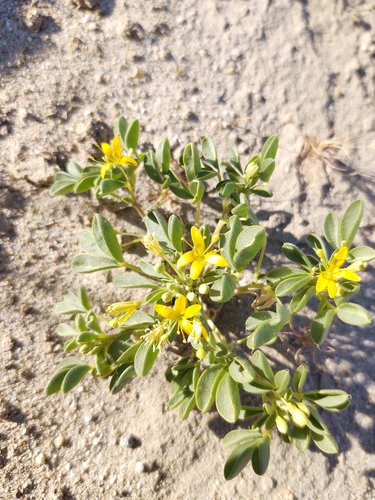


Mojave Stinkweed
cleomella obtusifolia
The Mojave Stinkweed is a fascinating desert survivor that brings vibrant bursts of color to some of North America's harshest environments. Native to the arid washes and alkaline flats of the Mojave and Sonoran deserts, this annual plant is distinguished by its pungent, musky aroma, which acts as a natural deterrent against herbivores. Despite its less-than-pleasant scent, it plays a vital ecological role, providing critical nectar for desert pollinators during the scorching summer months.
Lebensraum: Typically found in highly alkaline desert flats, dry lake basins, sandy washes, and disturbed desert soils of the southwestern United States.
Mojave Stinkweed is a low-growing, highly branched annual herb typically reaching 10 to 45 centimeters in height, forming sprawling, rounded clumps. It features fleshy, light-green leaves divided into three small, rounded leaflets. Its most striking feature is the dense clusters of bright yellow to gold flowers with protruding, long stamens that give them a delicate, spidery appearance, followed by distinct, fan-shaped seed capsules.
Kategorie
PflanzenSeltenheit
Common
Gefahr
1/5 · Sehr gering
Snaps
Mach den ersten Snap!
Its pungent odor, which earns it the 'stinkweed' moniker, is due to the same mustard oil compounds found in wasabi and horseradish.
The distinctive fan-shaped seed pods swing outward on long, thin stalks, which helps the desert wind shake and disperse the seeds.
While most desert wildflowers disappear by May, the Mojave Stinkweed can continue to bloom and thrive through the triple-digit heat of July and August.
Produces pungent glucosinolates (mustard oils) that emit a strong, unpleasant odor to deter hungry desert herbivores.
Possesses specialized physiological adaptations that allow it to thrive in saline and highly alkaline soils where other plants cannot survive.
Capable of blooming and producing seeds during the extreme heat of mid-to-late summer when most other desert annuals have withered.
As a photoautotrophic plant, it manufactures its own energy from sunlight, water, and carbon dioxide through the process of photosynthesis.

Pontia protodice
The caterpillars of this butterfly feed on the leaves and flowers, utilizing the plant's chemical compounds for defense.
Gopherus agassizii
This tortoise occasionally feeds on the fleshy foliage and flowers of the stinkweed in desert washes.
Pogonomyrmex rugosus
These desert ants harvest and consume the oil-rich seeds dropped by the plant.
Für dieses Objekt sind noch keine Merkmal-Badges vergeben.
Noch keine Alternativnamen vorhanden.
Sammlungen für dieses Objekt erscheinen hier, wenn weitere Themen hinzugefügt werden.
Gefahr
1/5 · Sehr gering
Noch keine besonderen Sicherheitshinweise.
Der einfachste Weg, Mojave Stinkweed zu bestimmen, ist die Verwendung der Naturführer-App Snappit.
10-45 cm
0.05-0.3 kg
1 Jahre
As a photoautotrophic plant, it manufactures its own energy from sunlight, water, and carbon dioxide through the process of photosynthesis.
Typically found in highly alkaline desert flats, dry lake basins, sandy washes, and disturbed desert soils of the southwestern United States.
Zoome hinein, um Cluster aufzulösen und zu sehen, wo dieses Objekt fotografiert wurde.
Neueste Snaps erscheinen hier, wenn neue Beobachtungen hinzukommen.














_Vicia_sativa.jpg&width=800)