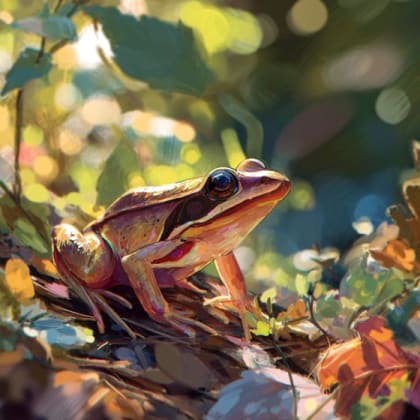
Moor Frog
Rana arvalis
The Moor Frog is a small, lively frog that loves to hop around in wetlands and ponds. They have beautiful blue and green colors, especially during spring when they are ready to mate!
Lebensraum: Wetlands
The Moor Frog is a small amphibian, typically brown or grey, with a distinct dark 'mask' behind its eyes. Males spectacularly turn vivid blue during their spring breeding season, making them easy to spot.
Kategorie
AmphibienSeltenheit
Common
Gefahr
1/5 · Sehr gering
Snaps
Mach den ersten Snap!
Wow! During spring, male Moor Frogs transform into a stunning blue color just to impress the females!
Wow! Moor Frogs lay their eggs in big gelatinous clumps called 'frogspawn,' often containing thousands!
Wow! These amazing frogs don't drink water; they absorb it right through their permeable skin!
Wow! They don't have ears like us, but can hear sounds using a membrane behind their eyes!
Moor Frogs can temporarily turn bright blue during breeding season, which helps males attract mates.
Moor Frogs have powerful hind legs that help them jump many times their body length to escape danger.
Moor Frogs can hibernate buried in mud at the bottom of ponds, surviving cold winters safely.
Moor frogs love to snap up small bugs and worms with their sticky tongues for a tasty meal!
Altersunterschiede: Tadpoles eat tiny plants and decaying matter, while adult frogs are carnivores.
Natrix natrix
A common predator that hunts adult Moor Frogs.

Ciconia ciconia
Large birds that prey on frogs in wetlands.
Formica rufa
A common insect often caught by Moor Frogs.
Araneus diadematus
Spiders are a regular part of a Moor Frog's diet.
Soziale Tiere leben in organisierten Gruppen und kooperieren, um ihr Überleben zu sichern, beispielsweise bei der Nahrungssuche, Verteidigung und Aufzucht der Jungen.
Farbenfroh beschreibt Organismen oder Objekte, die eine große Vielfalt an leuchtenden und deutlich erkennbaren Farben aufweisen.
Getarnt beschreibt Organismen, die über eine Färbung oder Musterung verfügen, durch die sie mit ihrer Umgebung verschmelzen.
Dieses Merkmal kennzeichnet Organismen, deren Nahrung hauptsächlich aus Insekten und anderen kleinen Wirbellosen besteht.

Dieses Lebensraummerkmal kennzeichnet Arten, die in Feuchtgebieten vorkommen. Dies sind Landflächen, die dauerhaft oder saisonal mit Wasser gesättigt sind, darunter Marschland, Sümpfe und Moore.

Dieses Merkmal kennzeichnet Lebewesen, die bei der Jagd, Flucht oder Fortbewegung eine außergewöhnliche Schnelligkeit aufweisen.

Tagaktive Tiere sind hauptsächlich bei Tageslicht aktiv und ruhen oder schlafen in der Regel nachts.

Beschreibt Organismen, die Pollen übertragen und so die Befruchtung und Fortpflanzung von Pflanzen ermöglichen.
Noch keine Alternativnamen vorhanden.
Gefahr
1/5 · Sehr gering
Always watch where you step near ponds, and don't touch frogs unless an adult says it's okay.
4-7 cm
0.005-0.015 kg
5-10 Jahre
8 km/h
Moor frogs love to snap up small bugs and worms with their sticky tongues for a tasty meal!
Wetlands
Ambush
500-3000
Zoome hinein, um Cluster aufzulösen und zu sehen, wo dieses Objekt fotografiert wurde.
Neueste Snaps erscheinen hier, wenn neue Beobachtungen hinzukommen.