

Nanday Parakeet
aratinga nenday
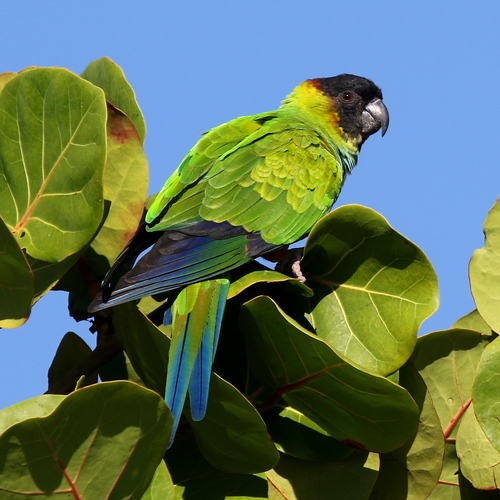
The Nanday Parakeet, also known as the black-hooded parakeet, is a highly social and vocal parrot native to the interior of South America. Famous for its striking appearance and boisterous personality, this medium-sized bird thrives in large, active flocks. They are renowned for their high intelligence, curiosity, and ear-splitting screeching calls, which they use to communicate across vast distances and maintain flock cohesion. While originally native to South American wetlands and savannas, they have successfully established self-sustaining, highly adaptable feral populations in urban areas across North America, notably in Florida and California, where they are often seen nesting in palm trees and utility poles.
Lebensraum: Typically found in open savannas, pastures, palm groves, and urban parks where they can easily forage and find nesting cavities.
Nanday Parakeets are easily recognized by their deep black facial mask or hood which contrasts sharply with their bright lime-green bodies. They feature a pale blue-green patch on their upper chest and distinctive bright red feathers on their thighs, giving them the playful appearance of wearing tiny red socks. Their wings showcase dark blue flight feathers that are highly visible during flight, complemented by a long, tapered green tail and a heavy, black hooked beak.
Kategorie
VögelSeltenheit
Common
Gefahr
1/5 · Sehr gering
Snaps
Mach den ersten Snap!
In feral North American populations, they are known to nest inside the hollow spaces of metal streetlights and utility poles.
Their bright red thigh feathers are often referred to as 'red boots' or 'socks' by bird enthusiasts.
They are highly social birds that are almost never seen alone, usually traveling in flocks of 10 to 30 individuals.
Possesses a two-toes-forward and two-toes-back foot structure that allows them to climb vertically and manipulate food with human-like dexterity.
Utilizes a loud, high-decibel screech that can travel over long distances to coordinate group movements and warn flock mates of danger.
Uses its powerful hooked bill to gnaw and expand natural tree hollows or wooden structures to build secure nesting sites.
Primarily feeds on a variety of seeds, fruits, nuts, berries, and flowers obtained from both native trees and urban ornamental plants.
Syagrus romanzoffiana
Feeds heavily on the sweet orange fruits of the queen palm, aiding in local seed dispersal in both native and urban environments.
Accipiter cooperii
Preys upon adults and juveniles in urban and suburban environments where feral parakeet populations have established.
Für dieses Objekt sind noch keine Merkmal-Badges vergeben.
Noch keine Alternativnamen vorhanden.
Sammlungen für dieses Objekt erscheinen hier, wenn weitere Themen hinzugefügt werden.
Gefahr
1/5 · Sehr gering
Noch keine besonderen Sicherheitshinweise.
Der einfachste Weg, Nanday Parakeet zu bestimmen, ist die Verwendung der Naturführer-App Snappit.
30-37 cm
50-55 cm
0.12-0.15 kg
15-30 Jahre
48 km/h
Primarily feeds on a variety of seeds, fruits, nuts, berries, and flowers obtained from both native trees and urban ornamental plants.
Typically found in open savannas, pastures, palm groves, and urban parks where they can easily forage and find nesting cavities.
Zoome hinein, um Cluster aufzulösen und zu sehen, wo dieses Objekt fotografiert wurde.
Neueste Snaps erscheinen hier, wenn neue Beobachtungen hinzukommen.









.jpg&width=800)






.jpg&width=800)

